
Beyond the Hype: Real Progress in Quantum Error Correction
The quantum computing field has seen its fair share of breathless headlines promising everything from instant drug discovery to cryptographic apocalypse. But something genuinely transformative happened in 2024 that cuts through the noise. Google’s latest quantum processor, Willow, achieved something researchers have been chasing for decades: demonstrating quantum error correction that actually reduces errors as you scale up the system.
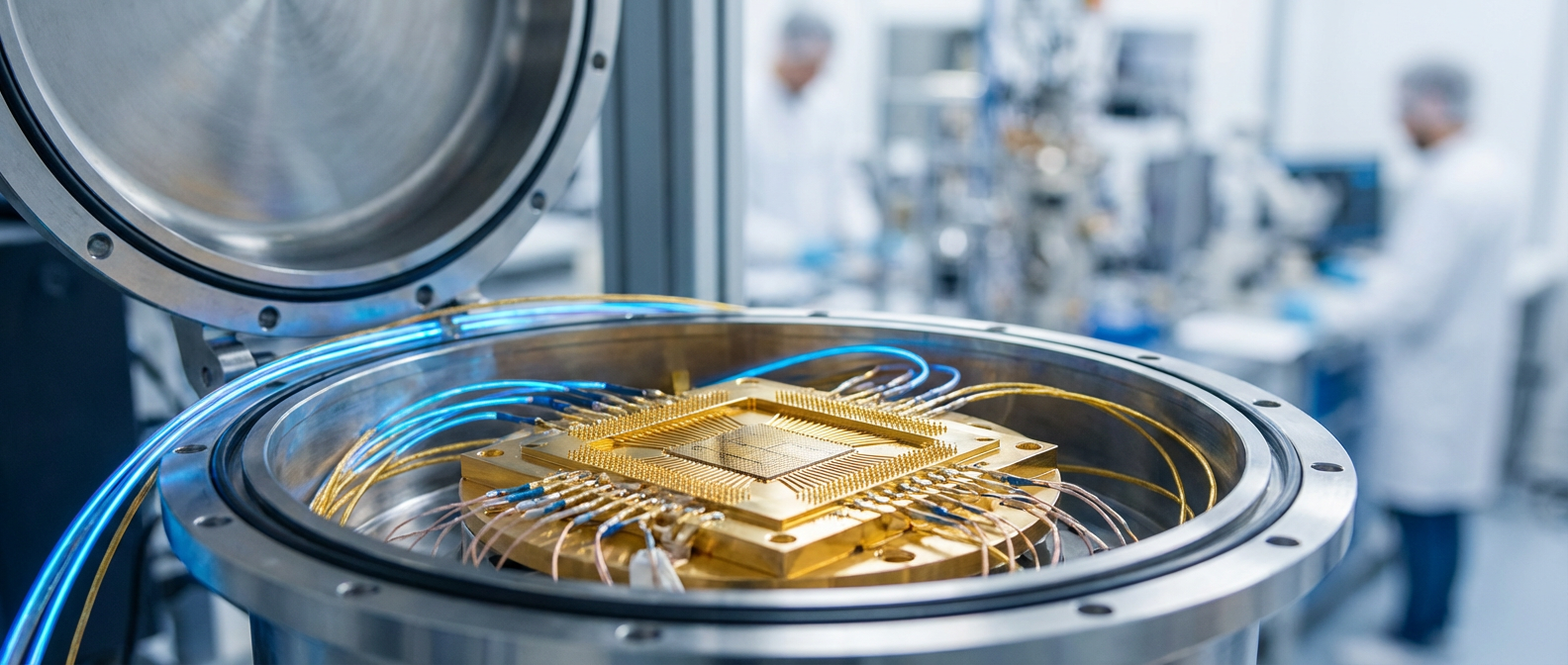
Here’s why this matters beyond the academic realm. Traditional computers use bits that are definitively 0 or 1. Quantum computers use qubits that can exist in superposition, simultaneously 0 and 1, until measured. This quantum weirdness enables exponential computational advantages for specific problems. The catch? Qubits are extraordinarily fragile. Environmental noise causes decoherence, destroying the quantum states faster than you can say “Schrödinger’s cat.”
Willow’s breakthrough lies in its implementation of surface codes across increasingly large arrays of qubits. When Google scaled from a 3×3 grid to a 5×5 grid to a 7×7 grid of qubits, the logical error rate decreased at each step. This isn’t just incremental progress. It’s the first experimental demonstration of below-threshold quantum error correction, meaning we’ve crossed the line where adding more qubits makes the system more reliable, not less.
The implications ripple far beyond quantum computing circles. Error-corrected quantum computers could revolutionize drug discovery by simulating molecular interactions that are computationally impossible today. Climate modeling could achieve unprecedented precision. Financial risk analysis could account for previously unmanageable complexity. We’re not talking about marginal improvements to existing capabilities. We’re talking about solving problems that are fundamentally beyond the reach of classical computers.

The Silicon Revolution: Room Temperature Quantum Dots
While Google grabbed headlines with Willow, another equally important development emerged from research labs focusing on silicon-based quantum computing. Teams at Intel and academic institutions have made substantial progress with silicon quantum dots that operate at temperatures achievable with standard dilution refrigerators, a big step toward practical quantum systems.
Traditional quantum computers require cooling to near absolute zero, typically around 10 millikelvin. This requires complex dilution refrigerators that cost hundreds of thousands of dollars and consume enormous amounts of power. Silicon quantum dots, essentially individual electrons trapped in silicon transistors, promise a more scalable approach. Recent advances have demonstrated coherent qubit operations at temperatures above 1 Kelvin, a seemingly small difference that represents a massive engineering advantage.
The beauty of silicon-based approaches lies in their compatibility with existing semiconductor manufacturing. TSMC and Intel already have the fabrication expertise to build these devices at scale. Unlike superconducting qubits that require specialized materials and processes, silicon quantum dots use the same fundamental technology that powers your smartphone. This convergence of quantum physics and semiconductor engineering could accelerate the timeline for practical quantum computers from decades to years.
What excites me most about this development is its potential for hybrid classical-quantum systems. Imagine quantum processing units integrated directly onto classical computer chips, enabling seamless transitions between classical and quantum computation within the same device. This isn’t science fiction anymore. It’s engineering optimization happening in real time.
Photonic Quantum Computing: The Dark Horse Candidate
While superconducting qubits and silicon quantum dots dominate quantum hardware discussions, photonic quantum computing has quietly achieved remarkable milestones in 2024. Companies like Xanadu and PsiQuantum have demonstrated photonic systems with hundreds of qubits, operating at room temperature with impressive coherence times.
Photonic quantum computers use particles of light, photons, as qubits. The advantages are compelling: photons interact weakly with their environment, maintaining quantum coherence even at room temperature. They travel at the speed of light, enabling rapid quantum operations. And they’re naturally suited for quantum networking, potentially connecting quantum computers across continents through optical fibers.
The challenge has always been creating the precise photonic circuits required for universal quantum computation. Recent advances in integrated photonics, particularly silicon photonics manufacturing, have begun to overcome these hurdles. Researchers have demonstrated deterministic two-photon gates and error-corrected logical qubits using photonic systems.
Perhaps most intriguingly, photonic quantum computers excel at specific computational tasks that could provide near-term commercial value. Quantum sampling problems, certain optimization challenges, and quantum machine learning applications show particular promise on photonic platforms. While these systems may not immediately threaten RSA encryption, they could solve commercially relevant problems years before fault-tolerant gate-based quantum computers become available.
The Scalability Challenge: From Dozens to Millions of Qubits
The quantum computing community faces a daunting scaling challenge. Current state-of-the-art systems operate with hundreds of qubits. Practically useful quantum computers will likely require millions of qubits. The gap between current capabilities and ultimate requirements represents one of the most complex engineering challenges in human history.
This scaling problem extends far beyond simply building more qubits. Quantum systems require precise control electronics, with each qubit needing individual addressing and readout capabilities. Classical control systems generate heat, which must be removed from the quantum processor. Crosstalk between qubits increases with system size, requiring sophisticated error correction and calibration protocols.
The 2024 breakthroughs in quantum error correction provide the theoretical foundation for scaling, but enormous engineering challenges remain. Companies are exploring radically different architectures: modular systems that link smaller quantum processors, distributed quantum computing across multiple locations, and hybrid approaches that combine different qubit technologies within the same system.
What gives me confidence about solving these challenges is the unprecedented level of investment and talent flowing into quantum hardware development. Major technology companies, governments, and venture capital firms have committed billions of dollars to quantum research. Universities are graduating quantum engineers at accelerating rates. The scientific community has aligned around common technical standards and benchmarks.
The Convergence Point: Why This Decade Matters
Multiple quantum hardware approaches are converging toward practical utility simultaneously. This convergence suggests we’re approaching a turning point where quantum computers transition from laboratory curiosities to commercial tools. The question isn’t whether this transition will happen, but how quickly different applications will become feasible and which hardware approaches will dominate specific use cases.
The implications extend beyond technology into geopolitics and economics. Countries and companies that achieve quantum advantage in important applications could gain substantial strategic advantages. China has invested heavily in quantum research infrastructure. The European Union has launched massive quantum initiatives. The United States has prioritized quantum computing in national security planning.
For individuals and businesses, the quantum transition requires preparation today. Cryptographic systems will need updating. Computational workflows will require redesign. New career paths in quantum engineering, software development, and applications will emerge. The companies that begin adapting now will be best positioned when quantum computers achieve broad commercial viability.
The hardware breakthroughs of 2024 represent more than academic achievements. They’re the foundation for transformative technologies that will reshape how we approach computation, optimization, and scientific discovery. The quantum future isn’t a distant possibility anymore. It’s an approaching reality that demands our attention and preparation. What aspects of this quantum revolution intrigue you most? The physics, the engineering challenges, or the potential applications that could emerge?