
The Magnitude of Our Search
Picture this: you’re standing in Times Square at midnight, surrounded by blazing billboards and neon signs, trying to spot a firefly hovering next to one of those massive LED displays. Now imagine that firefly is actually orbiting the billboard, and you’re not in Times Square but on the Moon, squinting through a telescope. This analogy barely scratches the surface of what astronomers face when hunting for exoplanets, but it begins to capture the staggering scale problem that makes every confirmed detection feel like a minor miracle.
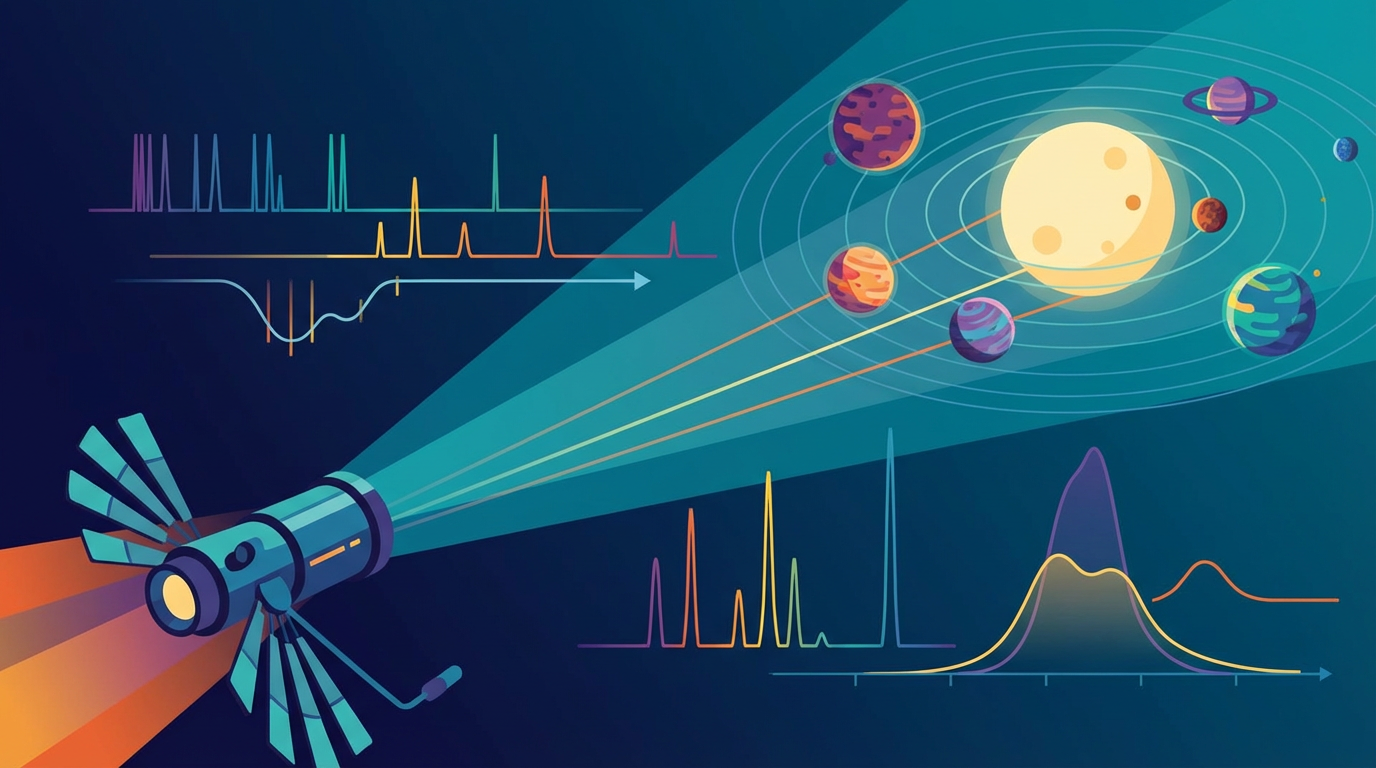
The numbers are brutal. A Sun-like star outshines Jupiter by roughly 1 billion to 1 in visible light. Earth? It manages only about 1/10 billionth the brightness of our Sun. When we talk about direct imaging of exoplanets, we’re basically asking our instruments to pick out a grain of sand sitting next to a lighthouse beam from hundreds of miles away. The scale disparity is so extreme that for decades, serious astronomers considered exoplanet detection nearly impossible.
Yet here we are, with over 5,000 confirmed exoplanets and counting. The transformation didn’t come from making our telescopes bigger or our detectors more sensitive, though both helped. It came from a fundamental shift in approach. We had to accept that the scale problem demanded indirect methods that could amplify tiny signals buried in cosmic noise.

The Transit Method: When Planets Become Shadows
The breakthrough that opened the floodgates was almost counterintuitive: instead of trying to see the planet directly, we learned to watch for its shadow. The transit method monitors stars for the tiny dimming that occurs when a planet passes between us and its host star. We’re talking about brightness decreases of 0.01% for an Earth-sized planet transiting a Sun-like star. To put this in perspective, imagine trying to detect when someone places a dime over a car headlight from 10 miles away.
The precision required pushed instrument design to extraordinary limits. The Kepler Space Telescope, launched in 2009, achieved photometric precision of about 20 parts per million. This means it could detect changes in starlight equivalent to a person in Los Angeles noticing when a single streetlight in San Francisco gets turned off. Kepler’s success wasn’t just about building better detectors. It required understanding and correcting for stellar variability, instrumental drift, and countless other sources of noise that could masquerade as planetary signals.
The statistical nature of transit detection adds another layer to the scale challenge. For any given planetary system, we can only detect transits if the orbital plane happens to align with our line of sight. This geometric probability is roughly the ratio of the star’s radius to the orbital radius, meaning only about 0.5% of Earth-like planets around Sun-like stars will produce detectable transits from our vantage point. We’re not just looking for needles in a haystack. We’re looking for the tiny fraction of needles that happen to be pointing in exactly the right direction.
Radial Velocity: Measuring the Unmeasurable Wobble
While transit photometry revolutionized exoplanet detection, the radial velocity method provided the foundation by proving that precision beyond human intuition was actually achievable. This technique measures the tiny Doppler shift in a star’s spectrum as it wobbles because of gravitational tugs from orbiting planets. Jupiter causes our Sun to move at about 12.4 meters per second, roughly the speed of a bicycle. Earth’s influence? A walking pace of about 0.09 meters per second.
The scale challenge here operates in the realm of spectroscopy, where we’re measuring wavelength shifts smaller than the natural width of spectral lines. Modern spectrographs like HARPS and ESPRESSO achieve precision of roughly 1 meter per second, equivalent to detecting the wavelength change that would occur if you could somehow make the entire star move toward or away from you at the speed of a leisurely stroll. This requires temperature stability better than a thousandth of a degree and mechanical stability that would make a Swiss watchmaker weep with envy.
The real magic lies in the details. To achieve such precision, these instruments use hollow cathode lamps or laser frequency combs as wavelength references, basically creating artificial stars with perfectly known spectra inside the spectrograph itself. They employ temperature-controlled vacuum chambers and vibration isolation systems that can detect when someone walks past the building. The scale of precision demanded by exoplanet detection pushed instrumental physics into territories previously reserved for fundamental physics experiments.
Direct Imaging: The Holy Grail Challenge
Even with the success of indirect methods, direct imaging remains the ultimate goal because it opens the door to atmospheric characterization and, potentially, biosignature detection. The scale problem here goes beyond simple brightness ratios and enters the realm of angular resolution and contrast control. Even the nearest stars appear as point sources to our largest telescopes, making planet-star separation a challenge measured in milliarcseconds.
Consider Proxima Centauri b, our nearest exoplanetary neighbor. At a distance of 4.24 light-years, this potentially habitable world orbits its star at a separation that appears from Earth as roughly 37 milliarcseconds. This angular scale is equivalent to distinguishing between two objects the width of a human hair held 100 meters away. Current ground-based telescopes, fighting through atmospheric turbulence, struggle to achieve this resolution consistently.
The next generation of space-based telescopes promises to tackle this challenge head-on, but the engineering requirements border on science fiction. NASA’s proposed Habitable Worlds Observatory will need to suppress starlight by factors of 10 billion while maintaining optical stability across mirror segments spanning tens of meters. The James Webb Space Telescope already demonstrates some of these technologies, but at scales insufficient for Earth-analog detection around Sun-like stars.
Beyond Detection: The Characterization Frontier
As detection methods mature, the scale challenges shift toward atmospheric characterization and the search for potential biosignatures. Transmission spectroscopy during transits allows us to probe exoplanetary atmospheres by measuring how different wavelengths of starlight are absorbed as they pass through the planet’s atmospheric limb. The signal we’re chasing represents perhaps 0.001% of the total light from the star. Within that tiny fraction, we’re looking for even smaller spectral features that might indicate water vapor, oxygen, or methane.
The scale problem here operates across multiple dimensions simultaneously. We need enough photons to detect weak spectral lines, temporal stability to track signals across multi-hour transits, and spectral resolution fine enough to distinguish between different molecular species. Recent atmospheric detections of exoplanets like K2-18b and WASP-96b represent the cutting edge of what’s currently possible, but they’re mostly limited to large, hot planets with thick atmospheres that produce relatively strong signals.
The detection and characterization of exoplanets is perhaps the most ambitious scale challenge in modern astronomy. Every confirmed world represents a triumph over seemingly impossible odds, achieved through instrumental precision that pushes the boundaries of human engineering capability. As we stand on the threshold of potentially detecting atmospheric signatures of life beyond Earth, the scale problems only become more daunting. They also become more thrilling. The next decade promises telescopes and techniques that will make today’s achievements look quaint, opening new frontiers in our cosmic census that will undoubtedly reveal surprises we haven’t yet imagined.