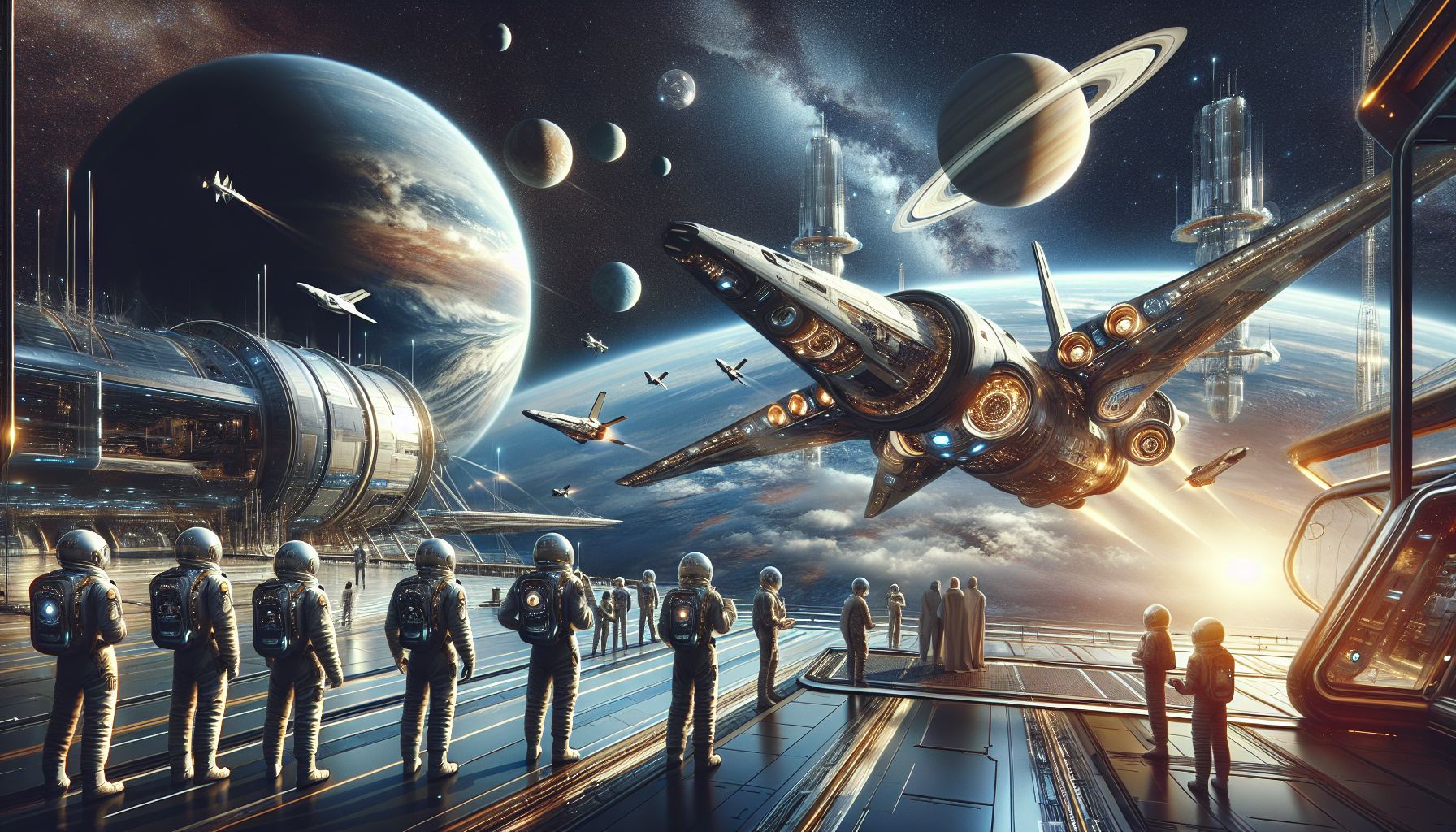

Hey there, fellow tech wanderers! Let me take you on a journey today that bridges the gap between two great unknowns: the cosmos and human innovation. We’re about to dive headfirst into the world of space travel—a place where science fiction is becoming science fact, and wild dreams are knocking at reality’s door.
The Galactic Dawn: Entering a New Era
Remember when space travel was the domain of governments and sci-fi movies? Astronauts were intrepid explorers in tightly budgeted missions funded by the superpowers of the world. Well, those days are behind us. We’re standing at the edge of a new space age, where private companies are figuring out ways to make traveling beyond our blue marble achievable, even routine. Imagine boarding a spaceship for your summer vacation. Wild, right?
Private Players with Galactic Grit
The private spaceflight industry has become a playground for billionaires and technophiles who share a communal sense of space fever. SpaceX, Blue Origin, and Virgin Galactic are leading the charge, each with its unique brand of space exploration. Elon Musk’s SpaceX, with its reusable rockets, is the apple pie of space travel tech. Musk isn’t just dreaming of Mars; he’s putting down the groundwork to make living on the Red Planet possible. Would I bet my savings on his Mars gamble? No. But watching it unfold is just as thrilling as binge-watching a new sci-fi series.
Blue Origin (yes, Amazon’s Jeff Bezos’s pet project) is jockeying to democratize space with ambitions for commercial spaceflight. Bezos famously said, “We are going to build a road to space so our kids can build the future.” It’s ambitious and inspiring and sounds terribly cool if you imagine it spoken over an epic soundtrack.
Let’s not forget Virgin Galactic, Sir Richard Branson’s dream of making suborbital spaceflights available to us normal Earthlings. Though it’s not quite a one-way ticket to the Moon, the idea of experiencing a few minutes of weightlessness and seeing the curvature of Earth? Honestly, sign me up (if someone else foots the bill).
Why Space? The Fuel Behind Our Cosmic Desires
What’s driving humanity’s new ambition to explore the stars? The reasons are as numerous as the stars we aim to visit.
Expanding Horizons and Cognitive Leapfrogging
There’s a philosophical itch that humanity’s always had, a yearning to explore. “To boldly go where no one has gone before” isn’t just a catchy phrase—it reflects our curiosity. Space exploration pushes the boundaries of knowledge and imagination, encourages innovation, and brings together multicultural collaboration. Think about it: we’re living a real-life Star Trek episode!
But beyond curiosity, space travel drives leaps in technology. These aren’t just minor upgrades; we’re talking leaps and bounds, technological cartwheels. The challenges of space push us to innovate in unexpected ways, often resulting in technologies that change everyday life here on Earth as well. Who wouldn’t want a smartphone built on warp-drive levels of innovation?
Resource Exploration and Economic Potential
Asteroids harbor unthinkable amounts of precious metals and minerals—platinum, gold, and even water. Yes, water! Space mining could potentially become a trillion-dollar industry, making Earth’s richest human look like pocket change in comparison. Some might say it’s a gold rush of astronomical proportions (pun fully intended).
Space tourism is another burgeoning market, promising to turn laypeople into astronauts. The idea is not just to take selfies while floating in zero-gravity, but also for space vacationing to contribute to economic growth, with potentially thousands of jobs being created in the process.
Challenges of the Cosmos
With every burgeoning frontier come challenges. Space, with its voids and anomalies, is no cakewalk.
The Cosmic Budget and Technological Hurdles
Space travel remains enormously expensive. It’s not exactly a budget-friendly weekend getaway—rockets aren’t like Uber ridesharing for starters. Tackling the financial costs continues to be a major obstacle, requiring creative financing and long-term investment strategies.
And let’s talk tech: landing a rover on Mars is one thing, ferrying humans safely back and forth is another. We need advances in life-support systems, habitat construction technologies, and sustainable fuel sources to name a few. Engineering the unthinkable is nerve-wracking, necessary work that’s bound to give sleepless nights to our brilliant scientists and engineers.
The Ethics and the Great Unknown
There’s also an ethical dimension in our cosmic discussions. Resource exploitation, the safety of future spacefarers, and environmental impacts of space debris need to be tackled with foresight and responsibility. We’ve only got one Earth, and it’d be kind of neat to not turn outer space into the galactic equivalent of a landfill. Nobody wants a starry sky littered with yesterday’s rocket parts.
Vision of the Future: Space as Norm
So, what’s looming on the galactic horizon? In the not-so-distant future, suborbital flights might become the norm, with a new breed of space aficionados who’ve perhaps logged as many terrestrial miles as orbits around the Earth.
Spaces like the Gateway Lunar Station, envisioned by NASA and international partners, could become the bustling microcosms of human activity, the celestial Grand Central Station. Imagine a future where Mars isn’t a distant, dusty entity, but more like humanity’s backyard.
Final Thoughts: Venture into the Infinite
Dear readers, we are living in audacious times, where space lore transitions from bedroom posters to boardroom agendas. The human spirit’s desire to explore, coupled with our technological prowess, means that in time celestial exploration will be a universally shared human pursuit.
While I might not be the first to trade my flip-flops for a space suit, I’m entirely thrilled at where we’re headed. Space, with its infinite horizons, beckons the dreamers, scientists, and adventurers. Most importantly, it opens doors for humans to realize we’re not just inhabitants of Earth, but citizens of the universe. And that, dear wanderers, is a journey worth dreaming about and taking.
Until next time, keep your head in the stars and your feet on the ground!