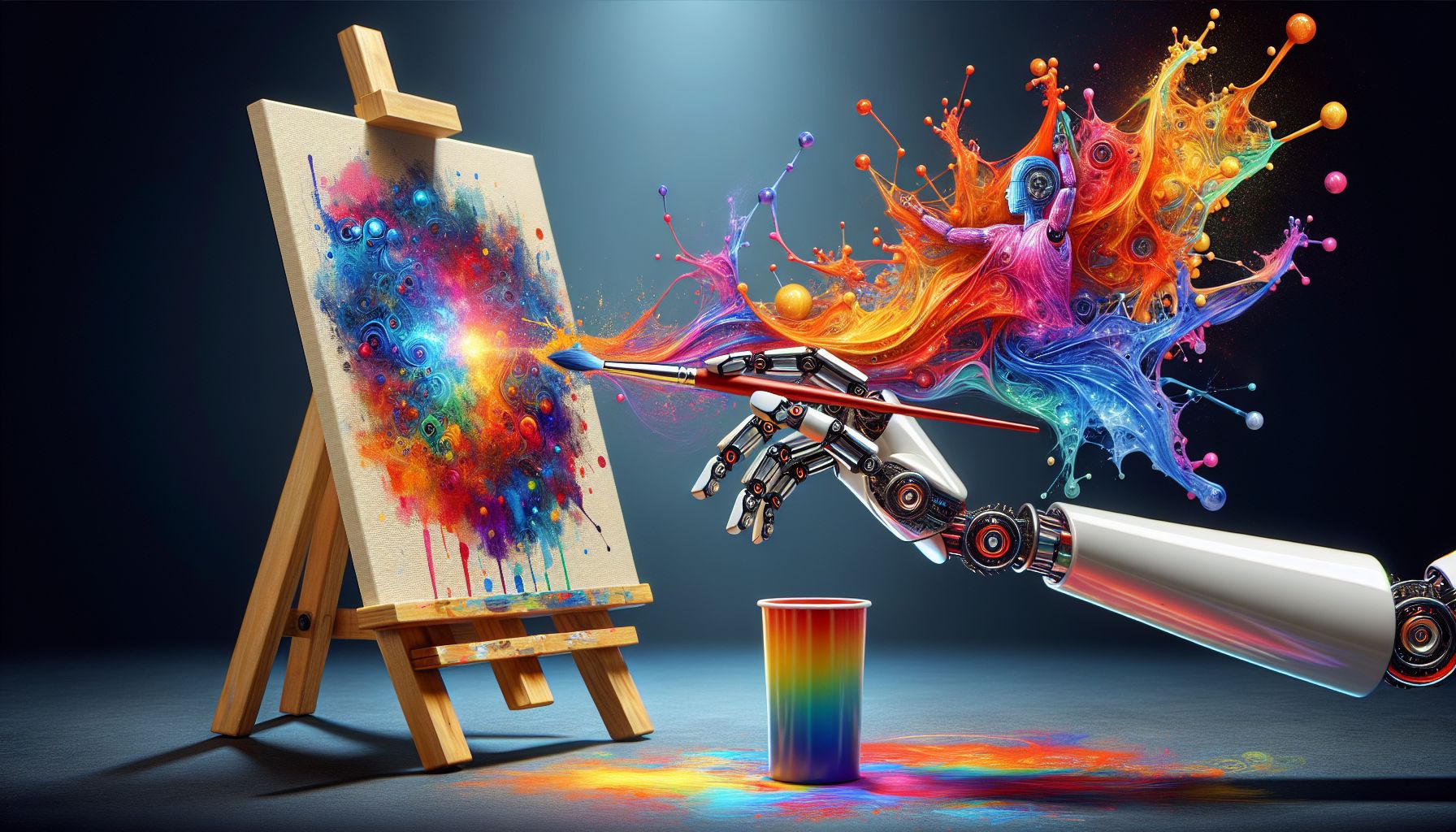

If you had told me a few years ago that artificial intelligence would one day be creating art that could hang in the Louvre and move us to tears, I probably would’ve chuckled and sipped my coffee incredulously. Yet, here we are in an age where AI is not just a tool but a real creative collaborator. Surprisingly, it’s taken the paintbrush from art’s solitary geniuses and handed it over to algorithms that can sketch, compose, and imagine in their own weird ways. Let’s jump into this fascinating crossroads of technology and creativity.
The Rise of the Machine Muse
Remember the first time an AI-generated piece of art made headlines? Because I certainly do. It was back in 2018 when a portrait created by the AI system “Obvious” sold at Christie’s for a jaw-dropping $432,500. The world was officially on notice: AIs were breaking into the art scene, and they weren’t playing around.
The excitement around this moment was both exhilarating and, let’s be honest, a little unnerving. Here we had an algorithm capable of producing unique pieces beyond simply solving cold, mathematical problems. This was when circuits and silicon moved into realms of human emotional expression, and honestly, nobody quite knew what to make of it.
Painting Outside the Lines: How AI Creations Work
So, how exactly does an AI “create”? If you’re imagining a robotic arm holding a brush, I hate to burst your bubble, but it’s a bit less tactile and a lot more data-driven than that. Most AI art generators are powered by Generative Adversarial Networks (GANs). These neural networks consist of two parts: a generator and a discriminator. Together, they tango in a digital dance of creation and critique.
The generator creates images, while the discriminator evaluates them against real-world examples from a vast pool of data. With every iteration, the generator learns from its mistakes until what it produces is indistinguishable from the works of human artists, or sometimes, even more imaginative.
A Canvas of Collaboration
What’s really interesting is how artists are beginning to embrace AI as an artistic partner. We often liken it to jazz, where the improvisation between the AI and its human creator can lead to unexpected, beautiful harmonies.
For example, AI has now moved into the music industry, with platforms like OpenAI’s MuseNet composing symphonies that could hit top charts. Even better, it collaborates with musicians, offering inspirations in real-time that come together into brand-new pieces. In film, we have AI-assisted scripts that explore narrative possibilities even the best writers might overlook.
I chatted with a tech artist friend, Mike, who uses AI to generate architectural visualizations. He described the experience as “painting with a living imagination,” and talked about how he develops his vision collaboratively as AI tools propose avant-garde designs that were impossible in the past.
The Human Touch in AI Art
Though immensely powerful, current AI artistry inevitably sparks a debate about the essence of creativity. Where does the soul of art live if algorithmic processes drive its creation?
One interesting perspective is that AI art is a mirror reflecting human creativity back at us. AI lacks its own consciousness, sure, but it still captures elements we program into it, from our unconscious biases to our aspirations about the whimsical boundaries of art. When you think about it, what is art if not a reflection of both the creator and interpreter?
I don’t think it’s about AI versus humans. It’s about blending human emotional depth with AI’s vast capability for pattern recognition, creating something that pushes both into uncharted territories.
The Horizon Ahead for AI Art
Looking into the future, it’s not hard to imagine AI art being part of mainstream conversations, galleries, and even our living rooms. Artists will increasingly see machine partners as another tool, just one more option in their arsenal to stretch the boundaries of what creativity can achieve.
However, just as with the advent of the camera, AI-driven art will force us to question and eventually redefine our measures of taste, originality, and emotional connection within the creative realm.
So there it is, a vision where AI doesn’t just co-opt our world but enriches our understanding of it. Personally, I’m excited about a future where AI isn’t just my helpful assistant but a co-conspirator in creative chaos. After all, who knew robots could dream in color? I can’t wait to see what colors they’ll splash onto their digital canvases next.
Closing Thoughts
I hope you found this exploration into AI in the creative arts as interesting as I did. It’s a realm where technology doesn’t just enhance our capabilities but transforms them into something completely new. The next masterpiece might just come from an unlikely collaboration between a human mind and an algorithm. Let me know in the comments what aspects of AI in art fascinate you the most. Until next time, keep dreaming in technicolor.