
The Problem with Popular Metaphors
Every time LIGO announces a new gravitational wave detection, the headlines inevitably describe “ripples in spacetime” or “wrinkles in the fabric of space.” I cringe a little each time, not because these metaphors are completely wrong, but because they create a fundamentally misleading picture of what gravitational waves actually are. After spending countless nights poring over papers from the LIGO-Virgo-KAGRA collaboration, I’ve realized that our most common explanations for gravitational waves might be doing more harm than good.
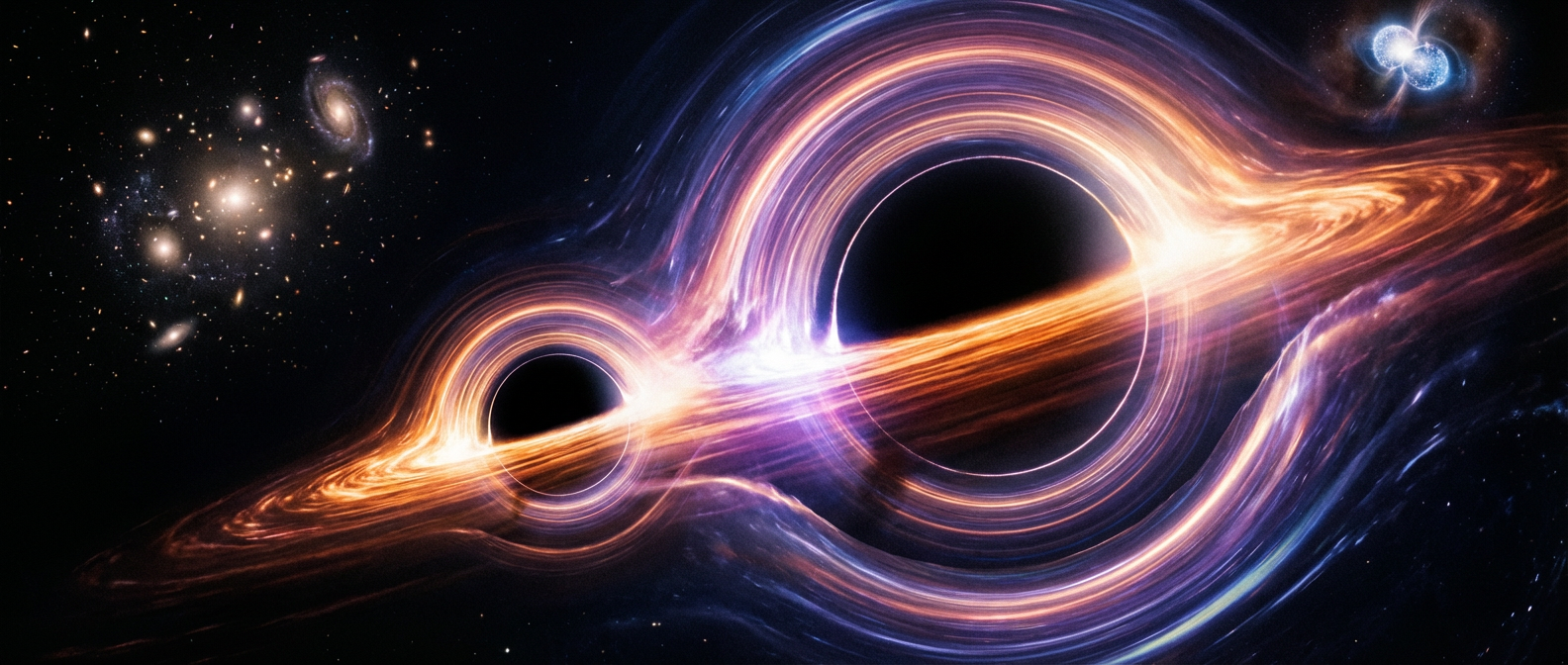
The ripple metaphor suggests something moving through a medium, like waves on a pond. But gravitational waves aren’t disturbances traveling through spacetime. They are disturbances of spacetime itself. When two black holes spiral into each other 1.3 billion light-years away, they don’t create ripples that move through some cosmic ocean. They literally stretch and compress the geometry of space and time, and this stretching spreads outward at the speed of light.
This distinction matters more than you might think. The ripple metaphor leads people to ask questions like “what medium do gravitational waves travel through?” or “how do they maintain their energy over cosmic distances?” These questions reveal a way of thinking that treats spacetime as a stage where physics happens, rather than understanding spacetime as an active player in the cosmic drama.

The Detector Confusion: LIGO Doesn’t Measure Movement
Another persistent misconception is about how LIGO actually works. Popular descriptions often claim that gravitational waves “cause the detector arms to shrink and expand” or that they “move the mirrors back and forth.” I’ve seen animations showing the mirrors physically bouncing around. This creates a completely wrong mental model of the detection process.
LIGO’s mirrors don’t move in any conventional sense. Instead, gravitational waves alter the metric of spacetime itself. When a wave passes through Earth, it changes the relationship between space and time coordinates. The distance between the mirrors changes because the meaning of distance itself changes. The laser light traveling between the mirrors takes a different amount of time to complete its journey, not because the mirrors have moved to new locations, but because the geometry of space has been temporarily modified.
This is why LIGO requires such extraordinary precision. The changes in the light’s travel time correspond to distance variations smaller than 1/10,000th the width of a proton. We’re not measuring mechanical motion. We’re measuring the dynamic evolution of spacetime geometry. The fact that we can detect these infinitesimal changes in the fundamental structure of reality never fails to give me chills.
The confusion here comes from our intuitive understanding of waves and motion. We expect waves to push things around, and we expect detectors to respond by moving. But gravitational wave detection operates on a deeper level, measuring changes in the very framework within which motion occurs.
The Speed Limit That Isn’t Really a Speed Limit
When discussing gravitational waves, many explanations emphasize that they travel at the speed of light, often adding that “nothing can travel faster than light.” This creates another subtle but important misconception. Gravitational waves don’t travel at the speed of light because they’re somehow constrained by a cosmic speed limit. They travel at the speed of light because they are the same type of phenomenon as light.
Both electromagnetic radiation and gravitational radiation are manifestations of field fluctuations moving through spacetime. In Einstein’s theory, the speed of light is really the speed of causality itself. It’s the rate at which cause-and-effect relationships can spread through the universe. Gravitational waves travel at this speed because they represent changes in the gravitational field, and field changes can only move at the speed of causality.
This connection became beautifully clear in August 2017 when LIGO detected gravitational waves from a neutron star collision, and telescopes around the world simultaneously observed the electromagnetic counterpart. The gravitational and electromagnetic signals arrived within seconds of each other after traveling 130 million light-years. This wasn’t just a confirmation that both signals travel at the same speed. It was a demonstration that we were witnessing the same cosmic event through two different aspects of the electromagnetic and gravitational fields.
The Binary Dance: More Than Just Objects Falling Together
Perhaps the most pervasive oversimplification involves describing binary black hole mergers as “two black holes falling into each other.” This framing suggests a simple story of gravitational attraction pulling objects together, like dropping a ball. But the reality of binary evolution is far more sophisticated and reveals the deep interconnection between matter, energy, and spacetime geometry.
When two black holes orbit each other, they’re not gradually falling inward because of some kind of cosmic friction. They’re losing orbital energy by radiating gravitational waves. The energy that once maintained their orbital separation gets converted into ripples in spacetime geometry that carry energy away from the system. As this energy leaves, the orbit tightens, which increases the orbital frequency, which increases the rate of energy loss. This creates a runaway process that ends in the final merger.
This process can take millions or billions of years for the early stages, but the final few seconds release more energy in gravitational waves than all the stars in the observable universe emit in light. We’re witnessing the conversion of pure gravitational potential energy into geometric distortions of spacetime itself. The black holes aren’t falling together. They’re transforming the energy of their orbital dance into waves in the fabric of reality.
What makes this even more remarkable is that we can hear this cosmic symphony. When LIGO converts its measurements into audio frequencies, we literally hear the death song of binary systems as their orbital frequencies sweep upward through our detector’s sensitive band. Each detection is a unique acoustic fingerprint of extreme physics playing out across cosmic distances.
Why These Misconceptions Stick and Why Precision Matters
These misunderstandings persist because they rely on familiar analogies that help make sense of genuinely alien physics. Ripples, movements, speed limits, and falling objects are concepts we understand intuitively. Curved spacetime, metric fluctuations, and field theory are not. The challenge for science communication is bridging this gap without sacrificing the profound weirdness that makes gravitational wave astronomy so revolutionary.
Getting these details right matters for more than just pedantic accuracy. Each misconception closes off certain avenues of understanding and wonder. When we think of gravitational waves as ripples rather than geometry, we miss the profound implications for our understanding of space and time. When we focus on detector movements rather than metric measurements, we lose sight of the extraordinary precision required to probe spacetime itself.
The real story of gravitational wave astronomy is stranger and more beautiful than any simplified metaphor can capture. We’ve developed instruments sensitive enough to measure changes in the structure of spacetime itself. We’re using those measurements to study the most extreme environments in the universe. And we’re doing all of this by listening to the geometric harmony of merging black holes and neutron stars.
If you want to learn more about any of these concepts, I’d love to hear your questions. The mathematics behind general relativity and gravitational wave theory can be intimidating, but the physical insights are accessible to anyone willing to think carefully about what these discoveries really mean for our understanding of reality.