
The Audacious Physics of Miniaturization
Last month, while scrolling through the latest papers from the National Ignition Facility, I found myself laughing at the sheer audacity of what we’re attempting with fusion energy. Here we are, trying to recreate the nuclear processes that power stars—events occurring at pressures exceeding 100 billion times Earth’s atmospheric pressure and temperatures of 100 million degrees Celsius—inside facilities we can walk around in an afternoon. The scale mismatch is so profound it borders on the absurd, yet that’s exactly what makes recent progress so thrilling.
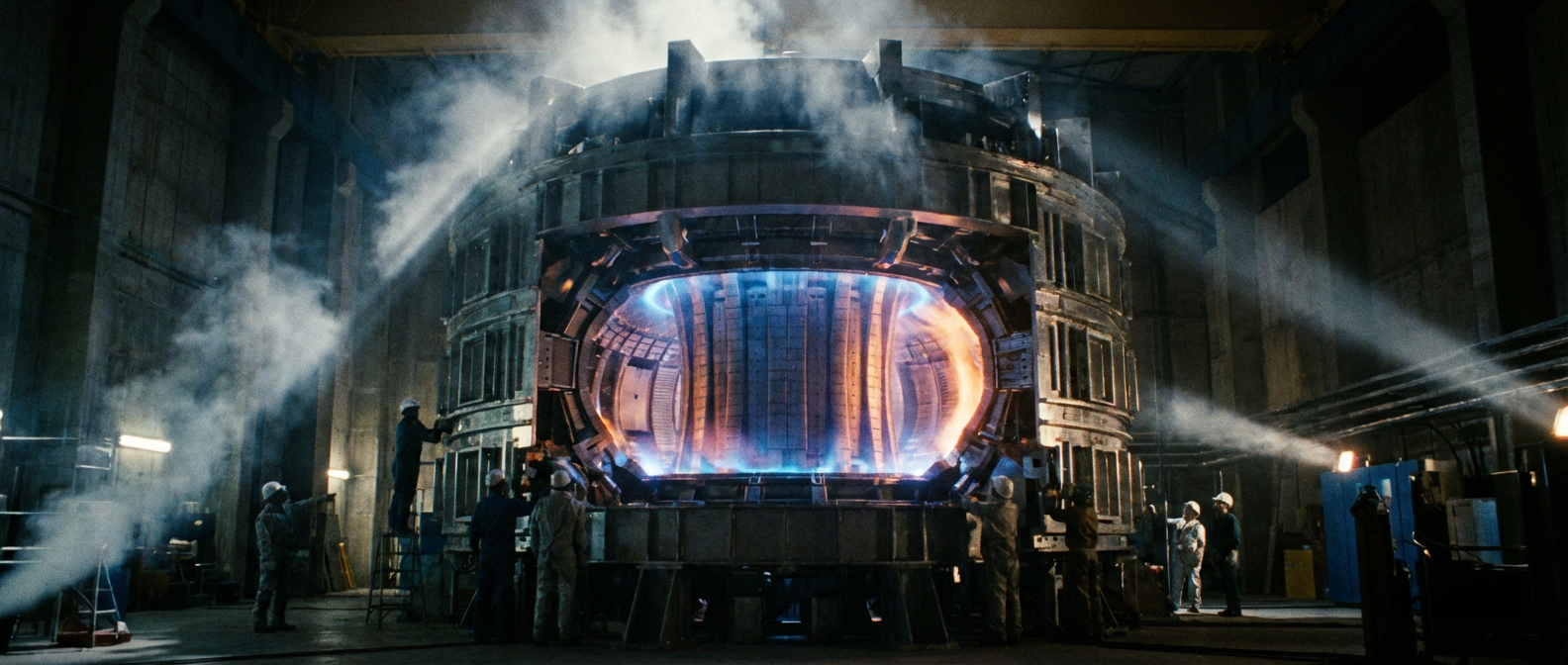
Here’s what I mean: if the Sun were scaled down to the size of a marble, the fusion reactions we’re attempting on Earth would be like trying to squeeze that marble’s nuclear furnace into a space smaller than a pinhead. And somehow maintain all its essential characteristics. The plasma densities, magnetic field strengths, and energy confinement times must all align within incredibly narrow parameters. We’re doing this with technology that fits inside buildings rather than stellar cores millions of kilometers across.
The December 2022 breakthrough at NIF proved it’s actually possible. Researchers achieved net energy gain for the first time in a controlled fusion reaction. But look at the specifics: 192 laser beams delivered 2.05 megajoules of energy to a fuel pellet smaller than a peppercorn, generating 3.15 megajoules of fusion energy. The reaction lasted mere nanoseconds and required the most powerful laser system ever built. Scaling this up to practical power generation means solving engineering problems that exist nowhere else in human technology.

The Engineering Enormity of Plasma Confinement
The scale problem gets even wilder when you look at magnetic confinement approaches like ITER, the international tokamak project currently under construction in France. ITER’s plasma chamber will contain about 840 cubic meters of superheated plasma, roughly equivalent to the volume of three school buses. This plasma is suspended in a magnetic field generated by superconducting coils that must be cooled to negative 269 degrees Celsius, just four degrees above absolute zero. The temperature differential between the plasma core and the superconducting magnets is one of the most extreme engineering environments ever conceived.
To appreciate the scale of magnetic confinement required, imagine trying to hold a writhing, luminous gas hotter than the Sun’s core using nothing but invisible magnetic hands. The magnetic field strength needed is approximately 100,000 times stronger than Earth’s magnetic field. It must be shaped with extraordinary precision. The slightest instability can cause plasma disruptions that release the energy equivalent of several lightning bolts in milliseconds, potentially damaging the reactor walls.
Recent advances in high-temperature superconducting magnets have enabled smaller, more efficient reactor designs. Companies like Commonwealth Fusion Systems are developing reactors with much stronger magnetic fields, up to 20 Tesla compared to ITER’s 5.3 Tesla. This allows them to achieve the same plasma performance in a machine roughly one-fifteenth the volume. This is a huge scaling breakthrough, though one that introduces entirely new challenges in materials science and magnetic engineering.
The Materials Challenge at Atomic Scales
Nowhere is the fusion scale problem more vividly illustrated than in the materials challenges facing reactor designers. The first wall of a fusion reactor must withstand neutron bombardment that will, over the reactor’s lifetime, displace nearly every atom in the material from its original position. To put this in perspective, if the atomic lattice of the reactor wall were scaled up so that each atom was the size of a marble, the neutron bombardment would be equivalent to a marble-sized projectile hitting every marble in a structure the size of a city, multiple times per second, for decades.
Tungsten is currently the leading candidate for plasma-facing materials. It must maintain its structural integrity while operating at temperatures approaching its melting point under constant particle bombardment. The helium produced by neutron interactions creates microscopic bubbles that can cause the material to become brittle and crack. Engineering solutions involve developing new tungsten alloys and nanostructured materials that can self-heal or accommodate this damage. These challenges push the boundaries of our understanding of atomic-scale material behavior.
The tritium breeding blanket presents another scale-dependent challenge that’s essential for fuel self-sufficiency. Lithium-containing materials surrounding the reactor must efficiently capture fusion neutrons and convert them to tritium while simultaneously generating the heat needed for electricity production. The neutron multiplication and tritium extraction rates must be optimized across length scales from nanometers to meters. This requires materials engineering that bridges atomic physics and industrial-scale manufacturing.
Economic Scaling and the Path to Practical Fusion
The economic dimensions of the scale problem reveal why fusion has remained “twenty years away” for so long. Current experimental reactors require enormous infrastructure investments. ITER’s total cost will exceed $20 billion while producing no electricity. The pathway to economically viable fusion power requires technical breakthroughs and scaling solutions that can reduce both capital costs and physical footprints.
Private fusion companies are approaching this challenge through radical scaling strategies. TAE Technologies is developing reactors that use alternative fuel cycles and advanced beam injection systems to achieve fusion conditions in much smaller devices. Their approach trades some of the well-understood physics of deuterium-tritium fusion for the potential of dramatically reduced reactor size and cost. Similarly, Helion Energy is betting on pulsed fusion approaches that could eliminate the need for massive continuous-operation infrastructure.
The most promising near-term applications may exploit fusion’s scaling advantages rather than competing directly with large-scale power generation. Compact fusion reactors could power remote installations, space missions, or industrial processes requiring extremely clean, high-energy-density power sources. These applications can justify higher costs per kilowatt-hour while proving the technology at smaller scales before attempting grid-scale deployment.
The Delightful Impossibility of It All
What continues to astound me about fusion energy development is how the scale challenges force us to push the boundaries of human technological capability in multiple directions simultaneously. We’re developing materials that operate under conditions more extreme than those found anywhere in the solar system except stellar cores. We’re creating magnetic fields with precision that would be impressive at any scale, but becomes almost incomprehensible when you realize we’re manipulating invisible forces to contain matter at temperatures that would vaporize any known material.
Recent progress in private fusion ventures, combined with advances in AI-assisted plasma control, high-temperature superconductors, and additive manufacturing, suggests we may finally be approaching solutions to the scale problems that have dominated fusion development for decades. Each breakthrough doesn’t just solve a technical challenge. It demonstrates that humans can indeed engineer solutions to problems that exist at the intersection of stellar physics and practical engineering.
The next few years will likely determine whether our species can successfully bridge the vast scale gap between stellar fusion and terrestrial power generation. I find myself checking the fusion research feeds almost daily, not because I expect sudden breakthroughs, but because I’m genuinely curious whether we’ll solve this magnificent puzzle through cleverness, persistence, or some combination of both. What aspects of the fusion scale challenge do you find most fascinating or bewildering?