
From Garage Startups to Orbital Highways
The transformation of space exploration from government monopoly to commercial marketplace is one of the most dramatic scale shifts in human history. What began as secretive national programs employing hundreds of thousands of engineers has become an ecosystem where private companies routinely launch payloads that would have been impossible just two decades ago. SpaceX’s Starship vehicle has successfully completed its orbital test flights and transitioned into commercial payload operations. This is the moment when space access shifted from scarcity to abundance.
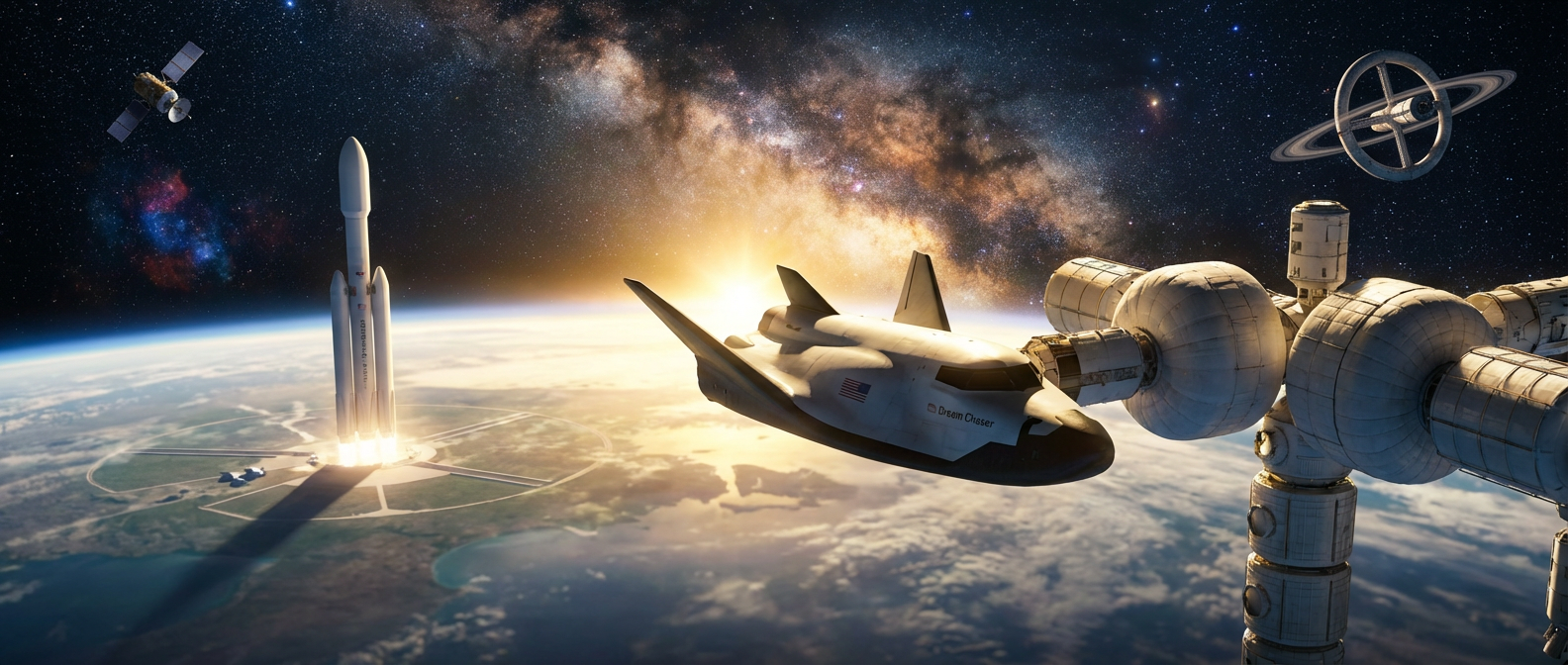
This transition shows us something important about technological revolutions: they often succeed not by doing things better, but by doing them at completely different scales. The Apollo program cost roughly $280 billion in today’s dollars to land twelve astronauts on the Moon. Today’s commercial space industry wants to make lunar access routine for a fraction of that investment per mission. The scale problem that once required the resources of superpowers can now be tackled by companies with the operational scope of major airlines.
Think about the logistics involved. NASA’s Artemis program plans to return humans to the lunar surface by 2026 or 2027, but unlike Apollo, this effort uses a distributed network of commercial providers rather than a single massive governmental undertaking. The scale has shifted from centralized gigantism to distributed specialization. Each component, launch vehicles, life support systems, communications networks, can be optimized independently and scaled according to market demand rather than political timelines.
The Infrastructure Revolution Orbiting Above
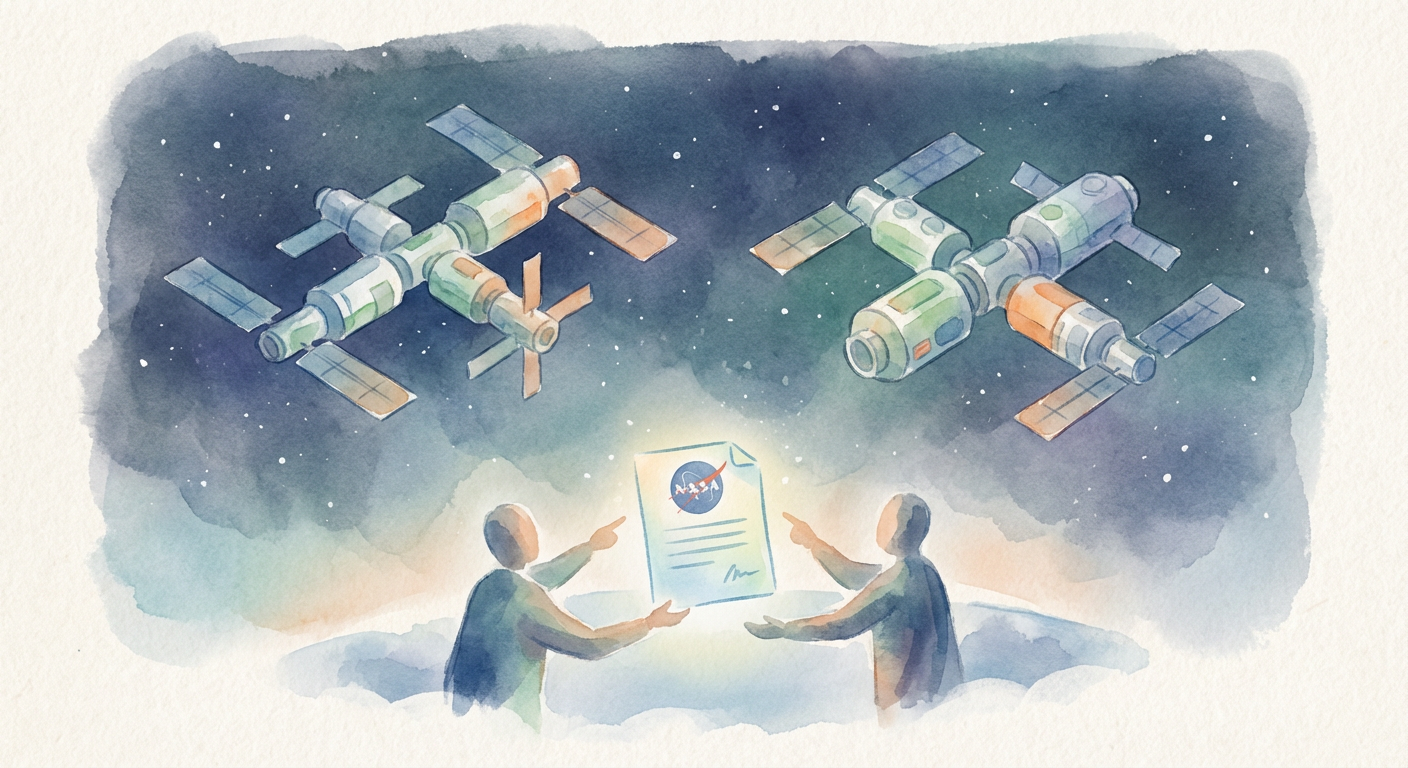
The scale transformation is most visible in the emerging commercial space station market. NASA has awarded contracts to Axiom Space and Blue Origin to develop commercial orbital platforms that will eventually replace the International Space Station. This is a big shift in how we think about permanent human presence in space. The ISS, a marvel of international cooperation, required the coordinated efforts of multiple space agencies over decades. Its commercial successors are being designed from the ground up for scalability and economic sustainability.
The comparison to terrestrial infrastructure development is striking. Just as the transcontinental railroad opened the American West through a combination of public vision and private execution, these commercial space stations represent the backbone infrastructure for an entire orbital economy. NASA news regularly highlights how these platforms will serve multiple customers simultaneously. Research institutions, manufacturing companies, tourism operators, and national space agencies.
The scale implications extend beyond mere capacity. When the ISS was designed, every kilogram of cargo required extensive justification and years of planning. Commercial stations are being engineered for routine operations where cargo flow resembles terrestrial shipping logistics rather than precious scientific expeditions. This shift from scarcity-based to abundance-based thinking fundamentally changes what becomes possible in low Earth orbit.
Mining the Void: Economics at Astronomical Scale
The asteroid mining industry shows how scale problems in space can flip traditional economic assumptions upside down. A single metallic asteroid contains more platinum than has ever been mined on Earth, yet the technical challenges of extraction make terrestrial mining seem simple by comparison. The United Nations is actively developing regulatory frameworks for asteroid resource extraction, recognizing that the scale of potential wealth involved could reshape global economics.
The scale mathematics are genuinely staggering. Earth’s annual platinum production amounts to roughly 200 tons. A single kilometer-wide metallic asteroid might contain 200 million tons of platinum-group metals. The disproportion is so extreme that it challenges conventional thinking about resource scarcity and abundance. Yet the energy requirements, technological complexity, and time scales involved in asteroid mining operations demand completely new approaches to project finance and risk management.
This scale inversion, where the most abundant resources exist in the most challenging environments, drives much of the current commercial space development. Companies are not simply trying to do terrestrial mining in space. They are reimagining industrial processes for environments where gravity, atmosphere, and proximity to Earth cannot be assumed. The regulatory frameworks being developed must account for operations that could fundamentally alter global commodity markets.
The Debris Dilemma: Scaling Responsibility
The rapid growth of commercial space activities has created a scale problem of a different sort: orbital debris management. New regulations requiring satellite operators to implement debris mitigation measures reflect growing recognition that space, despite its vastness, can become congested in the orbital zones most useful for human activities. The scale challenge here is temporal rather than spatial. Decisions made today about satellite design and disposal will determine the usability of orbital space for generations.
The comparison to environmental regulation on Earth is both appropriate and insufficient. Terrestrial pollution typically affects local or regional areas, but orbital debris at certain altitudes can render entire orbital zones unusable for decades or centuries. A collision in low Earth orbit doesn’t simply create a localized problem. It generates thousands of high-velocity fragments that pose risks across vast regions of space. The scale of potential cascade effects, where one collision triggers multiple others, requires precautionary measures that seem extreme by terrestrial standards.
Space News industry coverage increasingly focuses on these sustainability challenges as they become central to business planning. Companies designing satellite constellations must now factor debris mitigation costs into their operational budgets from day one, rather than treating them as external concerns. This represents a maturation of the industry, where long-term thinking about scale effects becomes a competitive advantage rather than a regulatory burden.
The $170 Billion Moon: Scaling Economic Projections
Economic forecasts project the lunar economy could reach $170 billion annually by 2040. This figure shows how dramatically our conception of space commerce has expanded. This projection includes not just scientific research or national prestige projects, but genuine industrial activities: manufacturing in low gravity, mining lunar resources, and using the Moon as a staging ground for deeper space exploration. The scale leap from the current lunar economy, essentially zero, to this projection requires infrastructure investments that dwarf most terrestrial industrial developments.
The lunar economy projection forces us to confront scale questions that have no terrestrial precedent. How do you establish supply chains across 384,400 kilometers of vacuum? What does quality control mean when your factory floor experiences two-week-long days and nights with temperature swings of 250 degrees Celsius? These aren’t simply engineering problems scaled up. They represent completely new categories of logistical challenges.
Yet the scale of potential returns justifies the enormous upfront investments required. Lunar manufacturing could produce materials impossible to create in Earth’s gravitational field. Lunar-based solar arrays could generate power without atmospheric interference or weather disruptions. The Moon’s low gravity makes it an ideal staging ground for missions to Mars and the outer solar system, where the scale of exploration jumps by orders of magnitude again.
The convergence of these scale transformations, from commercial launch capabilities to asteroid mining regulations to debris mitigation requirements, suggests we are witnessing not just the growth of existing industries, but the emergence of completely new economic sectors. The next decade will determine whether humanity can successfully manage these scale transitions, turning the infinite frontier into a sustainable extension of terrestrial civilization. The sheer audacity of these challenges makes them impossible to ignore.