Why Most “Earth-Like” Exoplanets Aren’t Actually Earth-Like at All

The Kepler-442b Problem When astronomers announced the discovery of Kepler-442b in 2015, headlines blazed with phrases like “Earth’s twin” and “potentially habitable super-Earth.” The planet orbits within its star’s habitable zone, where liquid water could theoretically exist on the surface. But here’s what those excited headlines didn’t mention: Kepler-442b receives about 70% more radiation than […]

Read Full Article

The Trillion-Dollar Rock Problem: Why Asteroid Mining Scale Defies Every Earthbound Analogy

When Numbers Break Your Brain Last week I found myself staring at a feasibility study claiming that a single metallic asteroid could contain more platinum than has ever been mined on Earth. The number was so large I had to check it three times. We’re talking about 16 Psyche, a roughly 140-mile-wide chunk of metal […]

Read Full Article

Why Asteroid Mining Feasibility Studies Are Missing the Real Questions

The Numbers Game That’s Distracting Us Every few months, another asteroid mining feasibility study lands on my desk claiming that a single metallic asteroid could contain more platinum than has ever been mined on Earth. The numbers are staggering: 16 Psyche supposedly holds $10,000 quadrillion worth of metals. These studies meticulously calculate extraction rates, processing […]

Read Full Article

Beyond Finding Worlds: How Exoplanet Characterization Is Reshaping Our Search for Life

From Detection to Dissection: The Evolution of Exoplanet Science When the Kepler Space Telescope revolutionized exoplanet detection through transit photometry, we celebrated each new world as a victory. Today, nearly three decades after the first confirmed exoplanet around a sun-like star, we’ve catalogued over 5,000 of these distant worlds. But here’s what keeps me awake […]

Read Full Article

Beyond Silicon Dreams: How Neuromorphic Computing Could Reshape Our Digital Future

The Brain-Inspired Revolution Taking Shape in Silicon Picture this: you’re watching your laptop struggle to recognize your voice while your brain effortlessly processes the same audio signal using roughly the same power as a dim lightbulb. This stark contrast isn’t just proof of biological evolution’s brilliance—it’s the driving force behind one of computing’s most promising […]

Read Full Article

When Silicon Dreams of Being a Brain: The Magnificent Scale Problem of Neuromorphic Computing

The Impossible Mathematics of Consciousness Picture this: your brain contains roughly 86 billion neurons, each one connected to thousands of others through an estimated 100 trillion synapses. Now imagine trying to recreate that biological masterpiece using traditional computer chips. The numbers alone should make any engineer break into a cold sweat. A single high-end graphics […]

Read Full Article

CRISPR Isn’t Magic: Why Gene Editing’s Real Promise Is More Complex Than the Headlines

The Oversimplified Promise That Captured Our Imagination Every few months, a headline screams about CRISPR “curing” another disease or creating “designer babies” with enhanced intelligence. These stories tap into our deepest hopes and fears about genetic manipulation, painting a picture of gene editing as either humanity’s salvation or its downfall. The reality? It’s both more […]

Read Full Article

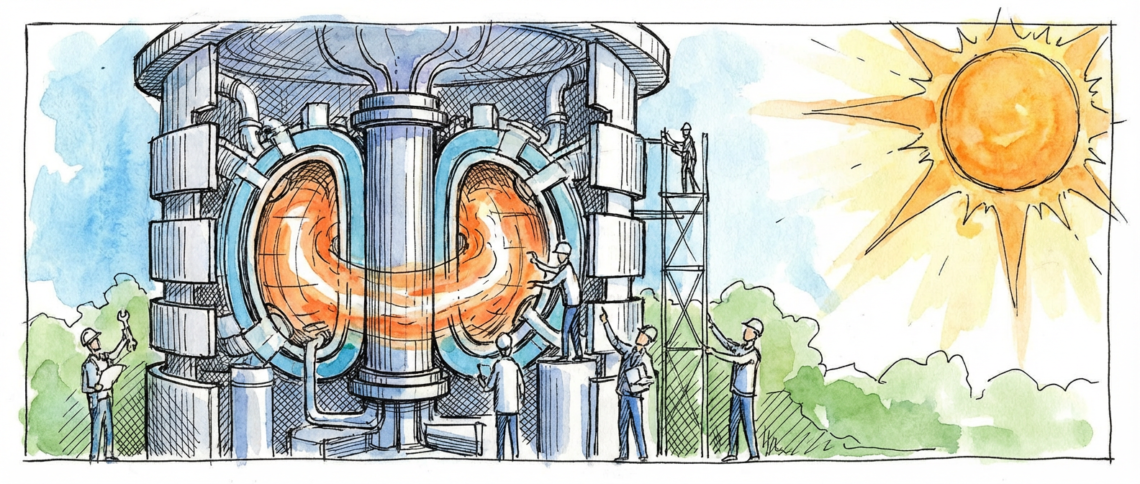
The Magnificent Scale Problem of Fusion Energy: Why Building a Star on Earth Is Harder Than It Looks

When Physics Meets Engineering Reality Last month, I found myself staring at a graph showing the energy confinement time for tokamaks over the past fifty years, and something clicked about why fusion energy remains perpetually “thirty years away.” The problem isn’t that we don’t understand the physics of nuclear fusion—we’ve been watching stars do it […]

Read Full Article

Inside the Lab Where Atoms Become Quantum Computers

The Temperature Challenge That’s Colder Than Deep Space At IBM’s quantum lab in Yorktown Heights, researchers work with dilution refrigerators that reach temperatures of 0.015 Kelvin—about 180 times colder than the cosmic microwave background radiation that fills empty space. This isn’t just impressive engineering theater. These extreme conditions are absolutely necessary because quantum computers rely […]

Read Full Article

The Fusion Breakthrough That Changes Everything (And What Actually Comes Next)

Beyond the Headlines: What National Ignition Facility Actually Achieved When the National Ignition Facility announced they had achieved fusion ignition in December 2022, the internet exploded with claims about unlimited clean energy being just around the corner. But here’s what actually happened: for the first time in human history, a fusion reaction produced more energy […]

Read Full Article