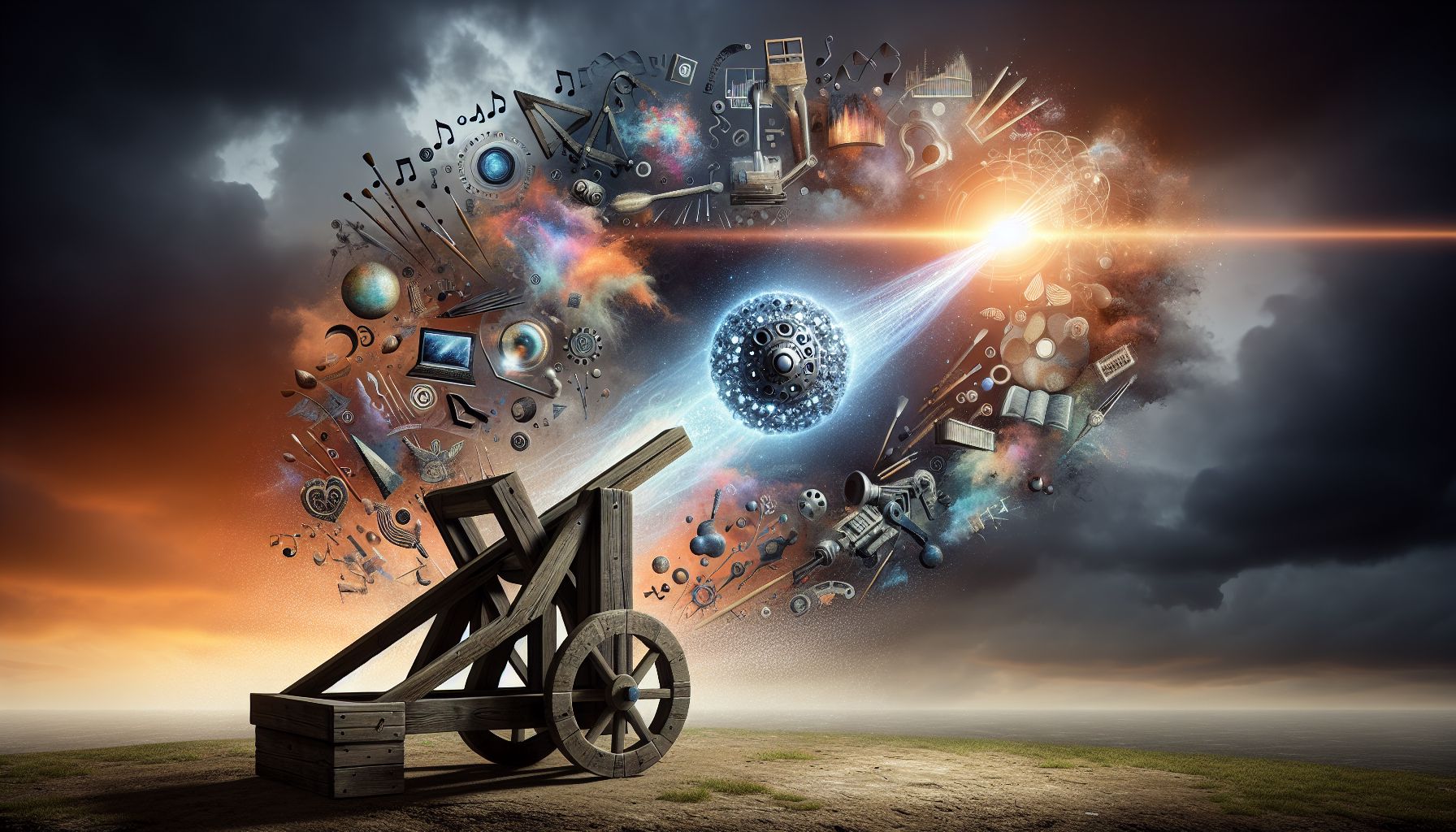

Welcome back, tech enthusiasts! I’m diving headfirst into an ocean of pixels and neural networks today. That’s right, folks, we’re talking about the fascinating intersection where artificial intelligence meets the creative arts. As someone who can barely sketch a stick figure, I’m constantly amazed by how AI is changing this space. Grab your digital paintbrush, and let’s explore this colorful world together!
The Dawn of AI in Art
It’s 2023, and we’ve reached a point where computers are no longer just number crunchers—they’re creators. Algorithms don’t merely understand art; they’re starting to make it. Pretty soon, we might be inviting AI-generated Van Gogh to dinner parties for a spirited debate on post-expressionism.
The most popular players in this game are the Generative Adversarial Networks (GANs). These digital art pioneers pit two neural networks against each other, one generating content and the other evaluating it, until, voila! You have something that even the Parisian art circles can’t snub. Remember DeepArt? That’s just the tip of the iceberg.
When Art Met the Algorithm: Modern Examples
One of the biggest moments in AI-art history was when an AI-generated portrait sold at Christie’s for a jaw-dropping $432,500 in 2018. Fast-forward five years, and we’re seeing an explosion of creativity. AI-generated music, for instance, has become a booming genre. Look at Spotify; tracks born from binary are making their way into playlists under monikers such as “Lo-Fi AI Beats”.
And who could forget OpenAI’s DALL-E? Its creativity knows no bounds, conjuring dreamlike images from simple text prompts. Last week, I got it to illustrate a mystical concept of “octopus-chess tournament on Neptune”—and let me tell you, it was nothing short of spectacular.
Making Art Accessible to Everyone
Here’s a delightful twist: AI art isn’t just for the digital elite. Tools like RunwayML and DeepDream allow everyday creators to experiment with machine-made muses. Whether you’re a professional graphic designer or someone who thought “render farm” was a gardening concept, there’s a place for you at this virtual easel.
This democratization of art creation means more voices, more diversity, and new perspectives. We’re tearing down the ivory tower of art elitism and inviting everyone to express themselves through the fusion of code and creativity.
Skynet with a Paintbrush? Addressing Concerns
It’s not all roses and rainbows, though. When machines start creating, there’s bound to be some unease. What about authenticity? Will AI art replace human artists? Is this Skynet making its first brushstrokes before taking over?
I get it. We’re treading into uncharted territory. The essence of “true” art, for many, lies in the distinctly human experiences it’s born from. That’s a narrative that’s still, miraculously, unfolding. Personally, I think AI is more of a sophisticated paintbrush than a complete artist. It can inspire new forms and processes but can’t, for now at least, capture the ineffable complexity of human emotion and experience. Instead of viewing AI as a rival, perhaps we should see it as an ally—one that helps human artists expand their horizons.
The Future is Now—And It’s Automated
Here’s where we put on our futurist hats and speculate. What lies ahead for AI in the creative arts? Imagine AI-enhanced immersive experiences, where VR art galleries dynamically change based on your emotional responses. Or AI-driven collaborations producing magical, generative art installations that respond in real-time to environmental conditions, transforming public spaces.
With every passing enhancement in computational power and algorithms, we’re edging closer to an era where AI might not just supplement creativity but also become a medium itself—an intriguing prospect for artists and technologists alike.
Wrapping It Up
Whether you’re an art buff, a tech nerd, or a curious bystander, there’s no denying that we’re witnessing a seismic shift in how art is created and consumed. AI isn’t here to replace artists; it’s here to broaden the scope of what can be made.
This exciting blend of artistry and technology is just one fascinating facet of the broader Fourth Industrial Revolution. So, as we eagerly watch these innovations unfold, rest assured that AI—and its digital da Vinci moments—are only going to get more fascinating. The canvas is digital, the palette is infinite, and honestly? I can’t wait to see what comes next. Ready to dive in?