
A Planet We Barely Know
Here’s something that keeps me awake at night, and I mean this literally—I was reading oceanographic surveys at two in the morning last week and had to text my friends about it: we have mapped the moon’s surface with higher resolution than we have mapped most of Earth’s ocean floor. Think about that for a moment. We’ve sent rovers to Mars, detected gravitational waves from colliding neutron stars billions of light-years away, and yet approximately 80 percent of our own planet’s oceans remain unmapped and unexplored at any meaningful resolution. We live on a world that is fundamentally mysterious to us.
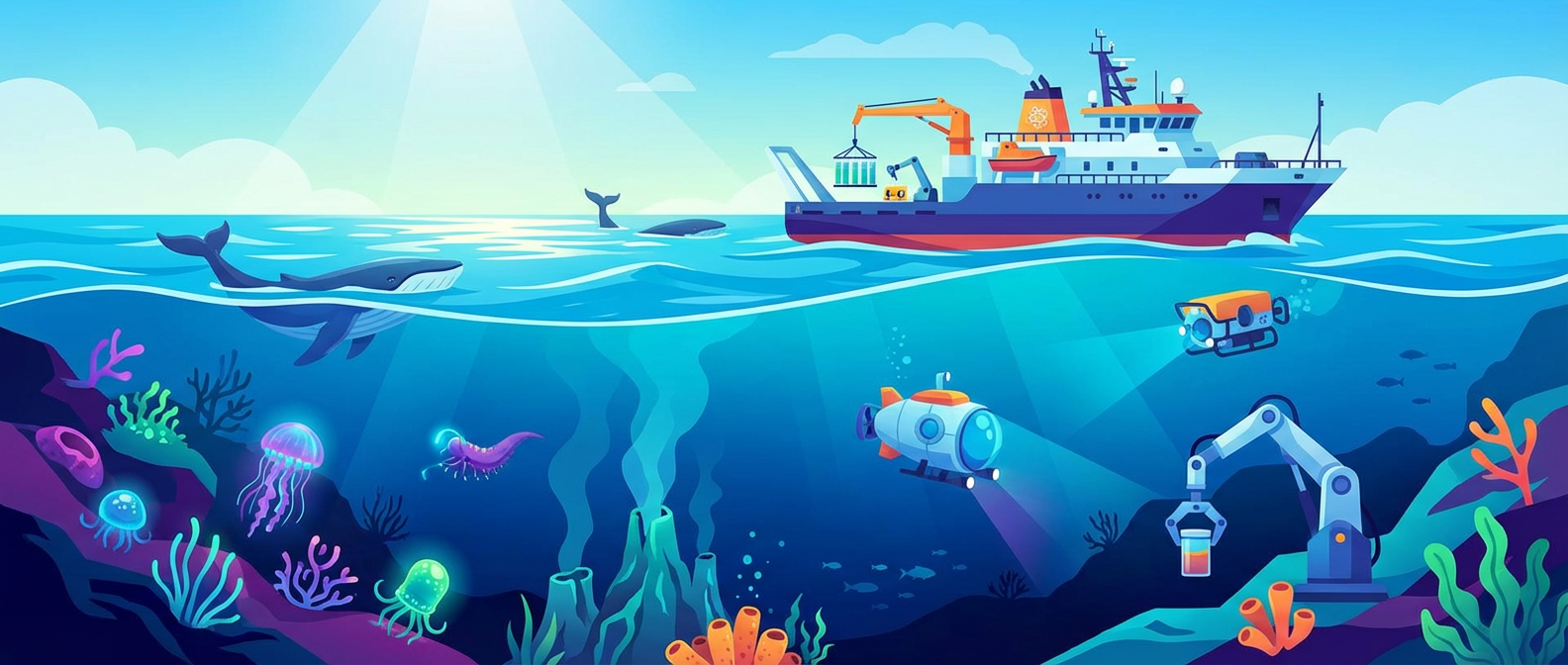
This isn’t just trivia for late-night scientific rabbit holes. The deep ocean is one of the most extreme environments accessible to human study, a realm of crushing pressure, near-freezing temperatures, and complete darkness that nonetheless teems with life in forms we’re only beginning to comprehend. Every research expedition into these depths returns with surprises, and sometimes the surprises are unsettling. The people doing this work, the scientists, the technicians, the engineers operating from research vessels and laboratory buildings all over the world, are engaged in something genuinely important: mapping the biological, chemical, and geological character of a place that profoundly influences our planet’s future.

New Tools, New Discoveries, New Questions
The pace of deep ocean discovery has accelerated dramatically over the past decade, thanks largely to autonomous underwater vehicles and remotely operated submersibles that can work continuously without the constraints of human physiology. These machines have transformed what’s possible in marine research. Where researchers once had to physically dive to specific locations, a process that consumed enormous time and resources, they can now deploy an autonomous vehicle, let it work through the night, and analyze the data the next morning. This technological shift has made intensive surveying affordable enough that teams can actually map vast stretches of seafloor and conduct systematic surveys of deep communities.
The results have been extraordinary. New species are being discovered from deep ocean surveys at a rate of roughly two thousand per year. Two thousand. Every year. We find new hydrothermal vent communities, new species of fish and crustaceans adapted to pressures that would crush a car, organisms that thrive in conditions we once thought utterly incompatible with life. Organizations like MBARI ocean research have entire teams dedicated to this work, publishing discoveries regularly that expand our understanding of how life can exist on this planet. It’s genuinely humbling. Just when we think we understand the boundaries of biology, the deep ocean shows us something that rewrites the textbook.
The Threat of Transformation
But here’s where the enthusiasm has to mix with urgency and concern. The same technological advances that allow us to explore these environments have also made extraction economically viable. Deep sea mining proposals have emerged globally, with companies and governments considering large-scale mining operations on the abyssal plains, operations that would fundamentally alter ecosystems we barely understand. Marine biologists across the world are raising alarm about this, and with good reason. We’re being asked to make irreversible decisions about systems we’ve only just started to study.
Simultaneously, we’re watching the chemistry of the entire ocean shift. Ocean acidification is occurring at the fastest rate in three hundred million years according to paleoclimate records. This isn’t a hypothetical future problem. It’s happening now, affecting shell-building organisms, coral systems, and the foundation of multiple food webs. And then there’s the matter of the plastic we’ve found at the deepest point of the ocean. The Mariana Trench, nearly eleven kilometers below the surface where sunlight has never reached, where the pressure is almost inconceivable, has shown evidence of plastic pollution since 2019 surveys detected it. That’s not just an environmental failure. That’s a symbol of how comprehensively human activity now touches every part of this planet.
The People Behind the Research
What strikes me most when I read papers from deep ocean research programs is the personality behind them. These are scientists who got interested in an organism or a process and have devoted their careers to understanding it despite every obstacle, funding limitations, the physical difficulty of working in extreme environments, the slow pace of peer review. They’re the ones who spend months preparing equipment for a research cruise that might yield a few days of actual deep-water work. They’re the technicians maintaining hundred-million-dollar research vessels. They’re the graduate students analyzing data sets so large that traditional methods don’t work anymore. Resources from organizations like NOAA Ocean Service support much of this work, which means this is publicly-funded research, your research, in a sense.
The generosity of these communities toward public engagement is something I genuinely appreciate. When I email researchers with questions about their work, most will write back. They’ll send me papers that aren’t yet published, explain their methodology, discuss the limitations of their findings with a candor that’s rarer than it should be. They’ll admit when they don’t know something, which in science is sometimes the most honest thing you can do.
Why This Matters Right Now
We’re at a moment where decisions about the deep ocean are being made without complete information, which is inevitable, but also consequential. Every species we haven’t discovered yet is a potential loss. Every ecosystem we haven’t mapped could be irreversibly altered by decisions made this decade. The urgency isn’t just scientific. It’s political, economic, and ethical. How do we balance the potential benefits of resource extraction with the possibility of destroying biological diversity we haven’t even catalogued? How do we address ocean acidification while continuing to depend on fossil fuels? These aren’t rhetorical questions.
What I find myself returning to, even at three in the morning with a cup of cold coffee and a stack of research papers, is the sense that we’re living through a window of opportunity. The technology to explore these places exists now. The scientific community is assembled and motivated. The questions are fascinating and urgent simultaneously. If you’re curious about how our planet actually works, about the frontier of human knowledge, about the intersection of scientific discovery and environmental responsibility, the deep ocean is where all of these concerns crystallize into something tangible and immediate. What questions about the ocean’s mysteries are you thinking about?