
When the Data Starts Whispering
There is a particular flavor of scientific frustration that arrives around 2 a.m., when you’re deep in a preprint and the numbers are telling you something that shouldn’t be there. This is the mood that has settled over CERN’s particle physics community in the past year, and not because anyone has made a grand discovery. It’s because the Large Hadron Collider’s Run 3 data, accumulating at unprecedented rates since 2022, keeps showing bumps and anomalies that refuse to behave like proper confirmation of known physics, yet stubbornly decline to reach the certainty threshold that would constitute genuine discovery.
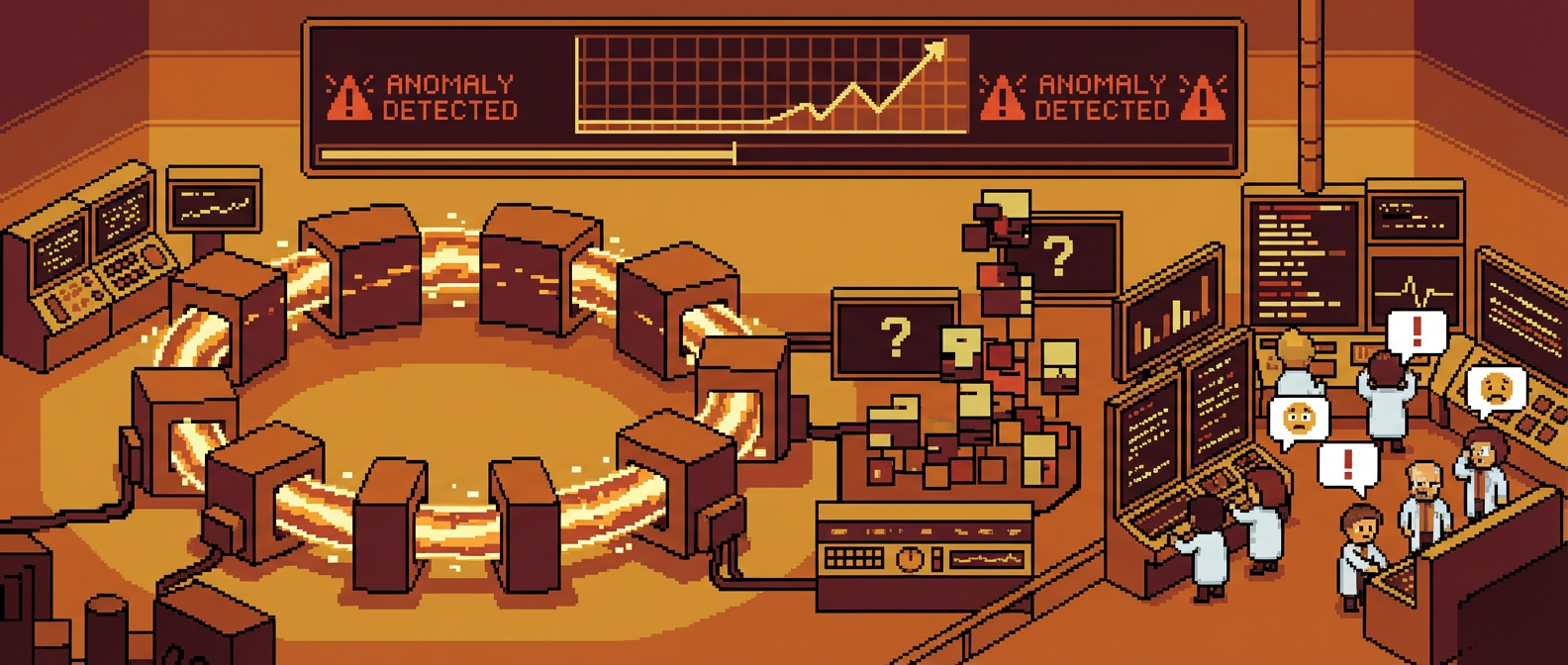
The scale of what we’re discussing deserves context. Since 2022, the ATLAS and CMS experiments have collected over 160 inverse femtobarns of collision data, an almost incomprehensible amount of information about how protons collide and what emerges from those violent encounters. This represents more data than the entire first two runs of the LHC combined. The detectors are working. The accelerator is performing. The infrastructure is humming along. And yet what the collaboration is seeing in this deluge of information is not straightforward confirmation of the Standard Model, nor unambiguous evidence of anything beyond it. Instead, we have a collection of intriguing tensions sitting in uncomfortable middle ground, neither ignorable nor proclaimable as breakthroughs.
The 2.8-Sigma Excess That Might Be Something
Consider what the CMS collaboration published in 2025. They reported an excess in the four-lepton invariant mass spectrum centered near 650 GeV. This is not nothing. A 2.8-sigma anomaly is unlikely enough to warrant serious attention from theorists, yet it falls frustratingly short of the 5-sigma threshold the field has established as the boundary between “interesting pattern” and “actual discovery.” The crucial detail is that this excess has appeared persistently across multiple data-taking periods, which suggests it might be real rather than a statistical fluctuation that will evaporate when more data arrives.
The Standard Model, that remarkably comprehensive framework that has predicted the behavior of nearly everything we’ve thrown at it for fifty years, offers no explanation for this bump. It shouldn’t exist. And yet it does, at least in the data collected so far. You can find the CERN CMS Collaboration Results published and available for scrutiny. Physicists will spend months analyzing these results, constructing alternative hypotheses, checking for systematic errors, and wondering whether they’re glimpsing physics beyond the Standard Model or simply watching a statistical mirage fade as the sample size grows.
The Pattern That Refuses to Settle
This situation repeats itself with variations across multiple LHC experiments. The LHCb experiment reported in 2025 that certain B-meson decay ratios show a 2.4-sigma tension with Standard Model predictions for lepton universality. This is familiar territory in an unsettling way. Similar anomalies emerged from LHCb data several years ago, generated considerable excitement, and then gradually diminished as additional measurements arrived. The field has learned to be cautious about these patterns. Hope has been chastened by experience.
What makes this moment strange is not any single anomaly, but the sheer prevalence of them. There are whispers in the collaboration that something systematic might be happening, whether that’s new physics waiting to be confirmed or a more subtle problem with how the community handles preliminary results. This distinction matters a lot. If these are genuine hints of new physics, we’re potentially standing at the edge of transforming our understanding of reality. If they reflect something more procedural, we’re looking at a problem of scientific culture that needs addressing.
The Institutional Question Nobody Wants to Discuss Publicly
Sabine Hossenfelder, a theoretical physicist who has become increasingly vocal about the state of the field, has argued publicly that the particle physics community has developed a troubling pattern. Anomalies between 2 and 4 sigma appear with regularity, generate attention and theoretical speculation, then vanish as data accumulates. She suggests this reflects a systemic problem in how preliminary results are reported and discussed, creating a cycle of hope and disappointment that may be distorting how the community allocates its intellectual resources. When Run 1 data generated anomalies that subsequently disappeared in Run 2, and now Run 3 is producing new anomalies, the question becomes whether we’re seeing genuine physics trying to announce itself or a methodological issue that needs confronting.
This is not an accusation of dishonesty. The physicists at CERN are careful, rigorous, and deeply committed to getting things right. The issue is subtler. It concerns the tension between the legitimate excitement that accompanies an unexpected result and the statistical reality that when you analyze data comprehensively enough, patterns will emerge that are more likely to be flukes than harbingers of discovery. When those patterns get reported and amplified through the scientific literature and popular media, they acquire a weight that pure statistics might not justify.
What Happens Next, and What We Learn Either Way
The High-Luminosity LHC upgrade, scheduled to come online in 2029, will reshape this entire landscape. That facility will deliver approximately ten times the current luminosity, meaning ten times more collisions and ten times more opportunities to catch genuine rare events, or confirm that today’s anomalies were simply statistical artifacts. According to physicists working on the CERN High-Luminosity LHC Project, this increase in data volume will either confirm the beyond-Standard-Model explanations that theorists have proposed for these anomalies or definitively rule them out. There is no middle ground when you’re looking at ten times more data. What is marginally significant today will either become undeniable discovery or disappear into the noise.
Until then, we inhabit an interesting moment. The LHC is performing brilliantly. The detectors are capturing data at rates that would have seemed impossible a decade ago. And the interpretations of that data sit in an uncomfortable limbo, neither dismissed nor confirmed. This is actually how science proceeds most of the time. The dramatic moments of clear discovery are rare. What’s more common is exactly this: data that tantalizes, theories that speculate, and physicists who maintain disciplined skepticism while harboring private hope.
The story being written at CERN right now is still being written. The anomalies might represent our first genuine glimpse at physics beyond the Standard Model, or they might be precisely what they statistically appear to be: interesting fluctuations in a very large dataset. We won’t know with confidence until we have more data, better analysis, and the intellectual honesty to follow the evidence wherever it leads, even if it leads back to familiar ground. What are you curious about in this space? Have you been following any particular anomaly or theoretical proposal?