
The Wavelength Revolution Transforming Astronomy
When the James Webb Space Telescope captured its first deep field images, the internet exploded with awe at those incredible visuals. But here’s what kept me awake until dawn that July night: buried in those infrared photons was evidence that our timeline of cosmic evolution might need serious revision. JWST’s observations of galaxies that formed just 400 million years after the Big Bang revealed structures far more massive and organized than our models predicted. These weren’t the small, chaotic proto-galaxies we expected to find in the universe’s infancy.
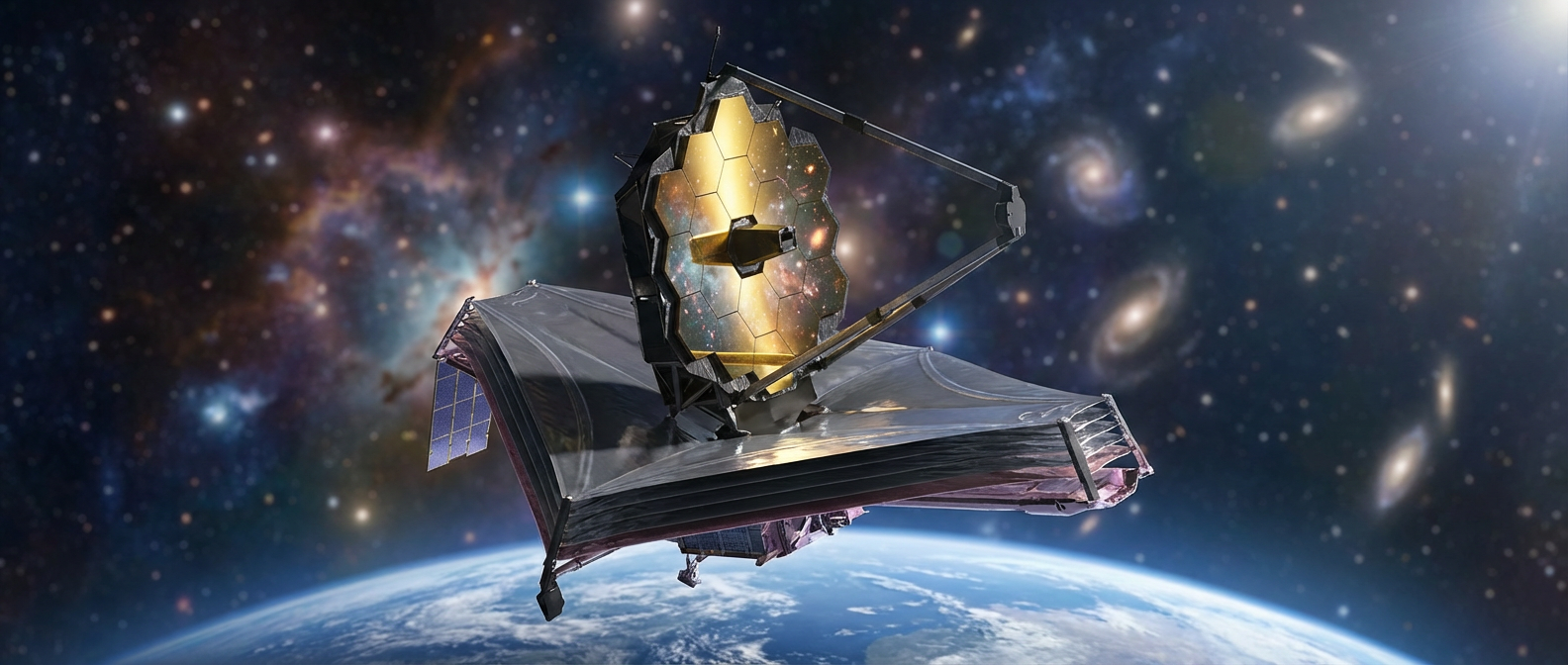
The implications ripple outward like gravitational waves through water. If massive galaxies assembled this quickly in the early universe, dark matter halos formed faster than we thought possible, or our understanding of star formation efficiency in primordial conditions is fundamentally wrong. This isn’t just about tweaking parameters in cosmological simulations. We’re potentially looking at a complete overhaul of how we understand structure formation, the first stars, and even the nature of dark matter itself.
What makes this discovery particularly compelling is how it emerged not from a single dramatic observation, but from careful analysis of infrared light that’s been traveling toward us for over 13 billion years. Each photon carries information encoded in its wavelength, intensity, and polarization. JWST’s infrared sensitivity allows us to decode this ancient cosmic correspondence with unprecedented clarity, revealing stories written in redshift and spectral lines.

Atmospheric Archaeology and the Search for Biosignatures
While cosmologists wrestle with early galaxy formation, exoplanet researchers are conducting atmospheric archaeology on worlds dozens of light-years away. The transit spectroscopy capabilities of JWST and other space telescopes have transformed our ability to analyze the chemical compositions of exoplanet atmospheres. When a planet passes in front of its star, starlight filters through the planet’s atmosphere. Different molecules absorb specific wavelengths, creating a unique spectral fingerprint.
The implications are already reshaping our understanding of planetary formation and evolution. Take WASP-96b, a hot Jupiter where JWST detected clear signatures of water vapor, along with evidence of clouds and hazes. This level of atmospheric detail was previously impossible to obtain. But the broader implications reach far deeper into astrobiology and our search for life beyond Earth.
Think about what happens when we can reliably detect and characterize water vapor, oxygen, methane, and other potential biosignatures in the atmospheres of rocky exoplanets in habitable zones. We’re not there yet with current technology, but the trajectory is clear. The next generation of space telescopes, building on JWST’s infrared capabilities, could detect atmospheric compositions that suggest biological processes. This capability will fundamentally alter how we approach the question of life’s prevalence in the universe, moving us from statistical speculation to direct observational evidence.
Gravitational Lensing as a Cosmic Magnifying Glass
One of the most elegant aspects of modern space telescope observations is using the universe itself as an optical instrument. Gravitational lensing, where massive galaxy clusters bend and amplify light from objects behind them, has become a powerful tool for probing the deep universe. Space telescopes can observe these natural magnifying glasses to study objects that would otherwise be completely beyond our reach.
Hubble’s observations of gravitational lenses revealed some of the most distant galaxies ever detected, but JWST’s infrared vision pushes this technique even further. By combining gravitational magnification with infrared sensitivity, we can now study the detailed structure and composition of galaxies that formed when the universe was less than 5% of its current age. These observations provide direct evidence about reionization, the period when the first stars and galaxies cleared the cosmic dark ages by ionizing the neutral hydrogen that filled space.
The broader implications extend beyond cosmology into fundamental physics. Precise measurements of gravitational lensing effects allow us to map the distribution of dark matter with unprecedented accuracy. These maps reveal discrepancies between observations and predictions from our standard model of cosmology, particularly regarding the clustering of matter on different scales. Such tensions might indicate new physics beyond our current understanding, or they could point to systematic uncertainties we haven’t yet identified.
Stellar Forensics and Galactic Chemical Evolution
Space telescopes are also revolutionizing stellar astronomy through detailed spectroscopic surveys that track the chemical evolution of galaxies across cosmic time. The Gaia mission has mapped the positions and motions of over a billion stars in our galaxy, while space-based spectrographs analyze their chemical compositions. This combination reveals the Milky Way’s merger history, showing how smaller galaxies were absorbed over billions of years and how their stellar populations contributed to our galaxy’s current structure.
These stellar forensics investigations have direct implications for understanding planetary formation. The metallicity gradients and abundance patterns we observe in stellar populations directly influence the types of planetary systems that can form in different galactic environments. Stars with higher concentrations of heavy elements are more likely to host rocky planets, while metal-poor stars from the galactic halo represent fossil records of the universe’s earliest stellar generations.
Looking ahead, the combination of Gaia’s astrometric data with spectroscopic surveys from space telescopes will enable galactic archaeology on an unprecedented scale. We’ll be able to trace individual stellar streams back to their parent dwarf galaxies, map the chemical signatures of ancient supernova explosions, and understand how feedback from star formation has shaped galactic evolution. This detailed understanding of our own galaxy provides the baseline for interpreting observations of distant galaxies across cosmic time.
The Convergence Point: Integrated Cosmic Understanding
What excites me most about the current state of space telescope science is how these different observational threads are beginning to weave together into a more complete picture of cosmic evolution. The atmospheric studies of exoplanets inform our understanding of planetary formation, which connects to stellar chemical evolution, which relates to galaxy formation and the large-scale structure of the universe. Each discovery creates new questions that can only be answered by combining multiple observational approaches.
The near-term trajectory is clear: more sensitive instruments, longer observing campaigns, and increasingly sophisticated data analysis techniques. But the longer-term implications reach toward questions that seemed purely philosophical just decades ago. If we can characterize thousands of exoplanet atmospheres and identify clear biosignatures, how will that change our understanding of life’s emergence and evolution? If gravitational wave astronomy and electromagnetic observations continue to converge, what new insights will emerge about the nature of space and time?
The data flowing from our current fleet of space telescopes represents just the beginning of this transformation. Each photon carries information that extends our understanding not just of individual cosmic objects, but of the fundamental processes that govern how complexity emerges from simplicity across the history of the universe. What keeps me up reading research papers isn’t just the latest discovery, but the recognition that we’re living through a period when human knowledge is expanding faster than ever before into realms that were previously beyond our reach.