
When Numbers Break Your Brain
Last week I found myself staring at a feasibility study claiming that a single metallic asteroid could contain more platinum than has ever been mined on Earth. The number was so large I had to check it three times. We’re talking about 16 Psyche, a roughly 140-mile-wide chunk of metal floating in the asteroid belt that might harbor $10,000 quadrillion worth of precious metals. That’s ten thousand times the entire global economy. My first instinct was to dismiss this as science fiction marketing, but then I started digging into the actual research, and the scale problem in asteroid mining turned out to be far more fascinating than any simple dollar figure.
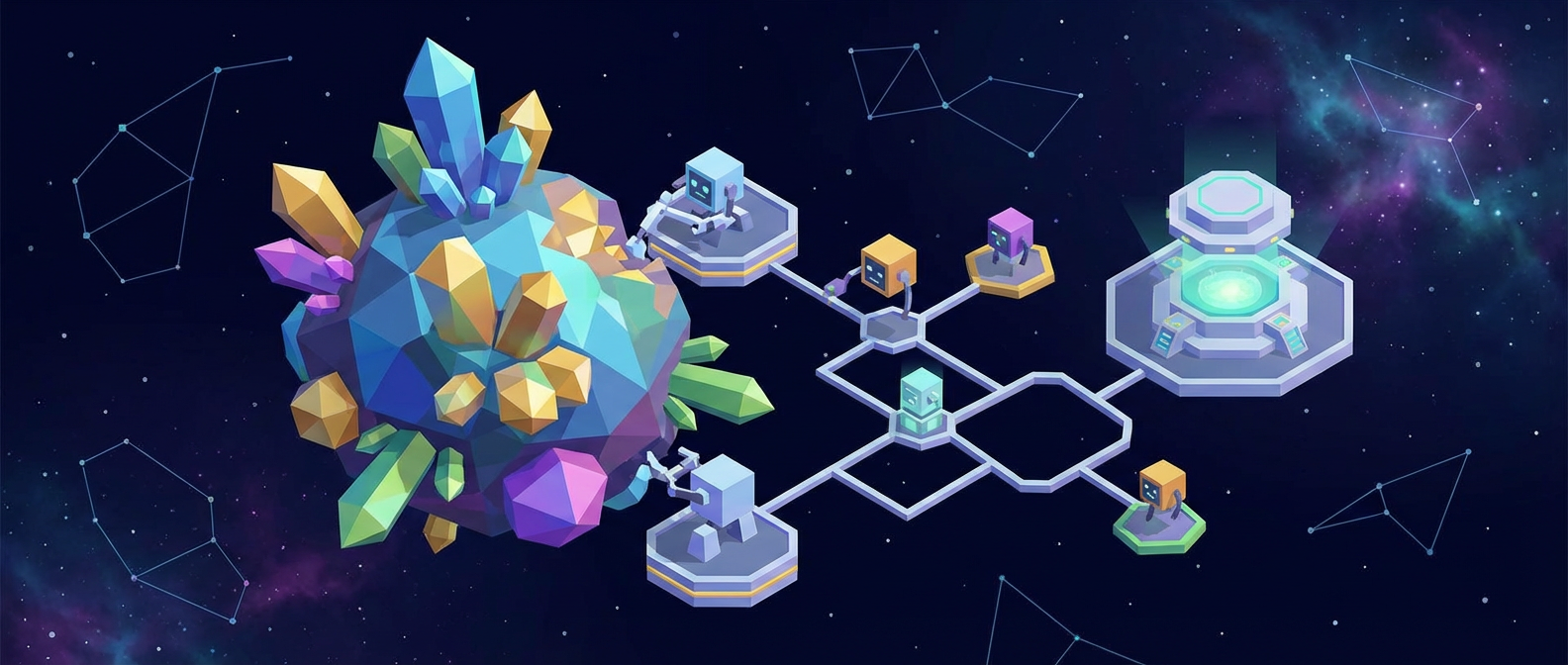
The fundamental challenge isn’t technological, though the engineering hurdles are genuinely staggering. It’s conceptual. Every analogy we use for asteroid mining breaks down because we’re dealing with scales that have no terrestrial equivalent. When mining engineers talk about extracting resources from space, they’re operating in a realm where our usual frameworks for understanding economics, logistics, and even physics become inadequate. The studies I’ve been reading suggest we need entirely new ways of thinking about resource extraction when the “mine site” is hundreds of millions of miles away and contains more raw material than civilization has used in its entire history.

The Deceptive Simplicity of Space Rocks
Here’s where the scale problem gets delightfully weird. A modest-sized metallic asteroid, say 500 meters across, contains roughly as much iron as the United States mines in an entire year. But unlike terrestrial mining, where you’re dealing with ore that’s maybe 1-2% metal content, these asteroids can be 30-90% pure metal. It’s like discovering a mountain made entirely of steel just sitting there in space, except the mountain is moving at 20 kilometers per second and is farther away than any human has ever traveled.
Recent spectroscopic analysis of near-Earth asteroids has identified over 9,000 potentially accessible targets within relatively easy reach of our current propulsion technology. The term “easy reach” is doing heavy lifting here. We’re talking about missions that would take 2-5 years each way, carrying equipment that doesn’t yet exist, to extract materials using processes that have never been tested in zero gravity. Yet the economic models keep spitting out numbers that make every other industry look like a lemonade stand.
The most sobering realization from these feasibility studies is that success would fundamentally break terrestrial commodity markets. If you could actually bring back just 1% of the platinum in a typical metallic asteroid, you’d crash the global platinum market so completely that the metal would become essentially worthless. This isn’t a bug in the economic modeling. It’s a feature that reveals how asteroid mining operates in a completely different economic paradigm than anything we’ve experienced.
The Infrastructure Paradox
Every serious asteroid mining proposal I’ve analyzed runs into the same beautiful paradox. To make asteroid mining economically viable, you need infrastructure in space. Orbital refineries, fuel depots, construction facilities, permanent human presence. But to build that infrastructure, you need the cheap materials that asteroid mining would provide. It’s a chicken-and-egg problem measured in trillions of dollars and decades of development.
The most promising near-term studies focus on water extraction rather than metals. Water can be split into hydrogen and oxygen for rocket fuel, making it potentially the most valuable substance in space though it’s nearly worthless on Earth. A single carbonaceous asteroid could contain more water than Lake Superior, and that water is already in space where it’s needed most. The scale here is more manageable but still mind-bending. We’re talking about turning asteroids into cosmic gas stations, creating fuel depots that could enable missions throughout the solar system.
Current feasibility models suggest that asteroid-derived water could reduce the cost of deep space missions by 90% or more. But here’s the catch that makes me lose sleep in the best possible way. The infrastructure required to capture, process, and store asteroid water would itself be one of the most complex engineering projects in human history. We’d be building industrial facilities that could operate autonomously for decades in an environment where the nearest repair shop is 100 million miles away.
The Timeline Reality Check
The most honest feasibility studies I’ve encountered put the timeline for profitable asteroid mining somewhere between 2050 and 2070. That might sound conservative until you consider what needs to happen first. We need to develop closed-loop life support systems, perfected robotic mining technology, space-based manufacturing capabilities, and probably fusion propulsion. Oh, and we need to solve the minor problem of keeping humans alive and productive in deep space for years at a time.
But here’s what gives me genuine excitement about these timelines. Unlike science fiction scenarios, these aren’t dependent on revolutionary physics breakthroughs. Everything required for asteroid mining already exists in principle. We have robots that can operate autonomously on Mars. We have life support systems that work on the International Space Station. We have spacecraft that can rendezvous with asteroids and collect samples. The challenge is scaling up these technologies by factors of thousands while making them reliable enough to operate without human intervention for decades.
The results from NASA’s OSIRIS-REx mission and Japan’s Hayabusa2 have provided crucial proof-of-concept data for asteroid resource extraction. These sample return missions demonstrated that we can navigate to specific asteroids, characterize their composition in detail, and extract materials using robotic systems. The scale difference between collecting a few grams of samples and extracting millions of tons of material is enormous, but the fundamental processes are now proven technologies.
Beyond the Numbers Game
What fascinates me most about current asteroid mining research is how it forces us to think beyond traditional economic models. When you’re dealing with resources that could supply human civilization for thousands of years, concepts like market saturation and commodity pricing become irrelevant. The real question isn’t whether asteroid mining will be profitable, but whether our economic systems can adapt to post-scarcity abundance for certain materials.
The latest feasibility studies suggest that asteroid mining might follow a completely different economic trajectory than any previous industry. Instead of extracting resources to sell on Earth, the real value might lie in using those resources to build infrastructure in space. Solar power satellites, Mars colonies, generation ships, orbital habitats. The asteroids themselves might become the foundation of a space-based economy that dwarfs anything happening on our planet.
The scale problem in asteroid mining isn’t really a problem at all. It’s an invitation to think bigger about humanity’s future than we’ve ever dared before. And that possibility keeps me up reading research papers until 3am, wondering if we’re standing on the threshold of the most significant economic transformation in human history.